
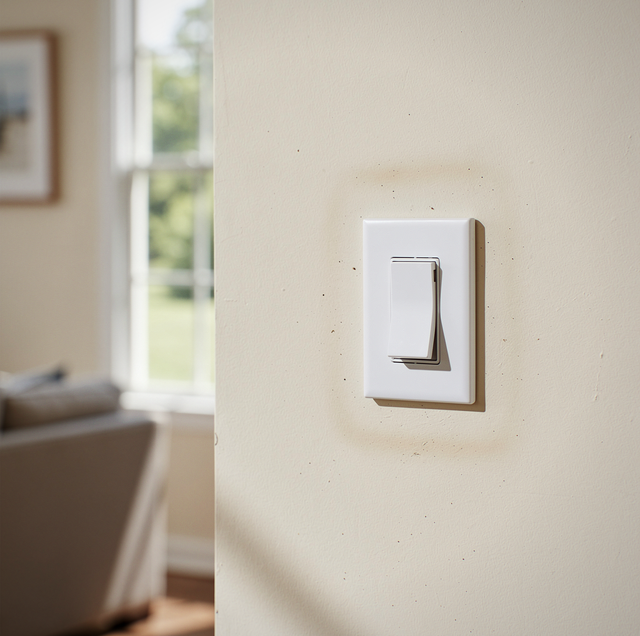
You reach for a light switch you have used ten thousand times, and the air around it is wrong. Hot plastic. Scorched dust. A sharp chemical edge that was not in the room a minute ago. The light might still come on, and the switch might feel cool under your finger. The smell matters more than either. It is your only evidence that something inside that box reached a temperature it was never built to survive.
Leave the building and call the fire service if you see smoke, see sparking at the switch, or notice the smell getting stronger by the minute. Do not stay to investigate, and do not go looking for the source.
Heat inside a switch box has a limited number of sources. Current moving through solid copper produces very little, whereas current crossing a poor connection produces a great deal. Almost every burning smell at a switch can be traced back to that difference, with a couple of exceptions.
Shut the Circuit Off Once You Have Ruled Out Smoke or Sparking
If none of the conditions above apply, cutting power to the circuit is the first move, and that happens at the panel, not at the switch. A wall or cover plate that feels warm or looks discolored belongs here rather than in the evacuation list: it is the ordinary sign of a joint heating behind the plate. Find the breaker that serves the room, move it firmly to off, and leave it there. A strip of tape across the handle stops anyone restoring it. If you cannot identify which breaker feeds that switch, shutting off the main is the fallback.
Standard house guidance on a breaker that trips by itself is to reset it once and stop if it trips again. A burning smell sits outside that rule: the breaker goes off and stays off until a licensed electrician has been inside the box.
Do not restore the breaker to see whether the smell returns. Reproducing it means running current through a connection that has already been shown to reach ignition temperature, with charred insulation now making the fault worse.
Heat in a Switch Box Comes From Resistance
Copper carries current almost for free. The cost shows up at the joints, where two conductors meet, and current has to cross from one piece of metal to another. A screw terminal, when tightened properly, clamps the conductor across a wide contact area, and almost nothing heats up. Back that screw off half a turn, and the contact shrinks to a few points of contact between metal. Current squeezes through that small patch, and the patch behaves like a small heater wired in series with the light.
Backstabbed connections create the same problem from the start. Those push-in holes on the back of a device grip the conductor with a small spring blade that touches one side of the wire, a fraction of the contact that a wrapped screw terminal provides. They work for years, then loosen as decades of heating and cooling cycle the metal.
A warming joint degrades itself. Heat oxidizes the contact faces, oxidation raises resistance, and higher resistance makes more heat. That loop is why a connection quietly warm for years can start smoking over one evening of heavy use.
Some Switches Are Carrying More Than They Were Built For
Every switch carries a printed current and voltage rating, commonly 15 or 20 amps, and the breaker trips long before added fixtures alone push a properly matched switch past it. The mismatches that bite are the ones the breaker cannot see: a 15-amp switch fitted on a 20-amp circuit, protected at a level above its own rating; a motor load such as a bath fan or a disposal exceeding the small motor rating a general-use snap switch carries; tungsten inrush many times the steady current on a switch rated only for resistive load.
Switches also wear out on their own schedule. Every time the contacts open, a tiny arc crosses the gap, and over tens of thousands of operations that pits and roughens the contact faces. A rough contact is a resistive one, and a switch that feels gritty or needs a firmer push is often already running warmer than it should. Motor loads accelerate that wear for the same reason.
Dimmers Shed Heat, and Some Installations Give Them Nowhere to Put It
A dimmer gets warm doing its job, and that warmth has to go somewhere. The metal strap and mounting yoke act as the heat path, moving energy into the box and the surrounding wall. Anything blocking that path raises the device's operating temperature.
Ganging is the usual culprit. Most dimmers have break-off side fins, and removing them to fit two or three side by side reduces how much load each can safely handle. Install three at full capacity with the fins snapped off, and the assembly runs hot every evening. A box crowded with spliced conductors, or one buried in wall insulation, removes the same escape route.
Load matching is the other half. An older dimmer designed around incandescent filaments controls an LED driver poorly, and the mismatch shows up as buzzing, flicker, and a device running warm.
Arcing and Shared Neutrals Heat a Box From Places You Cannot See
Part of what happens inside a switch box happens to conductors that only pass through it. Splices feeding other outlets and fixtures often live in the same box, capped and folded behind the device. A loose cap on one of those heats exactly the way a loose terminal does, and the smell reaches the switch you can reach, even though the switch itself is fine.
Arcing is the more dangerous version. When a connection separates slightly under load, current jumps the gap as a continuous string of tiny sparks. The temperature at that gap climbs far past what a steady resistive joint reaches, which is why arcing chars insulation, blackens the inside of a box, and sometimes announces itself as a faint frying sound behind the plate.
Shared neutrals add a failure most homeowners never hear about. In a multiwire branch circuit, two hot conductors share a single full-size neutral that normally carries only the difference between them, so if the two circuits are wired correctly, they cancel most of the return current. Miswire both hots onto the same panel leg and nothing cancels: the shared conductor carries the sum of both loads instead of the difference, heats along its length, and the smell surfaces at whichever connection was already weakest. A loose or open shared neutral fails differently. Heat and arcing occur at the joint itself, and with the midpoint no longer held, the two 120-volt circuits are in series across the full supply, so the voltage divides by the load rather than evenly. One side rises while the other falls, so lights on one circuit brighten as lights on the other dim.
What Different Burning Smells Point Toward
Smell turns out to be a reasonably specific diagnostic once you know what makes each one.
Sharp, acrid, plastic: Thermoplastic conductor insulation and modern device bodies give off a biting chemical odor as they soften and scorch. This is the smell that should move you to the panel immediately, because the material producing it is the material keeping conductors apart.
Fishy or chemical: Some of the plastics and heat-resistant chemicals used in device bodies and terminal blocks release a distinctly fishy, ammonia-adjacent odor when they overheat, older thermosets notably among them. Those materials char rather than melt, so the smell arrives well before there is anything visible to find.
Hot dust or hot metal: Dust settling on a warm heat sink, a recessed fixture housing, or a dimmer strap bakes and gives off a dry, faintly sweet, burning smell, which is less likely to point to a failing connection.
Varnish or hot motor: A fan motor controlled by that switch produces its own scorched-varnish smell from the winding insulation. The odor reaches the switch only because the switch sits near the fixture.
New fixture burn-off: A newly installed fixture, bulb, or dimmer sheds manufacturing oils, protective coatings, and cutting-fluid residue during the first several heat-ups. This one has no electrical fault behind it, and it fades on its own.
Why the Smell Outlasts the Problem That Made It
Odor molecules settle into everything porous within a few feet of their release point. Drywall, paint, dust, framing, and the paper facing on insulation absorb them and release them slowly, so the smell can hang in a room for hours or days after the source has cooled.
That timing catches people out. A smell that fades is not evidence the fault repaired itself. What faded was the residue, while the loose terminal or arcing splice that produced it sits in the box exactly as it was, waiting for the next time that circuit carries real current.
The pattern of the smell is more useful than its strength. One that appears only when the hall light and the bathroom fan are both running, or twenty minutes into an evening with the dimmer up, points at a connection that heats when current rises and cools when it drops. A faint, unchanging smell that never varies with what is switched on is more often residue from an earlier event.
Leave the Circuit Off Until a Licensed Electrician Has Seen It
Once the breaker is off, the urgency drops and diagnosis begins. An electrician confirms the box is dead with a tester, opens it, and reads the physical evidence: discoloration on a terminal, a device body deformed around its screws, a wire nut with browned conductor ends, insulation gone stiff and dark along the last inches of a conductor.
That last item is why replacing the switch is rarely the whole repair. Heat travels along copper, so a terminal that ran hot cooks insulation back inside the cable, and the damaged section has to be found rather than covered up by a fresh device.
None of that is homeowner work, for a concrete reason. Confirming a conductor is dead requires the right instrument and the technique to use it. A switch box can hold conductors from more than one circuit, so killing the breaker you expect to matter does not guarantee that everything inside is de-energized.
Frequently Asked Questions
Yes. A switch interrupts only the conductor feeding its own light. On a three-way pair, one traveler stays energized in every switch position, so charred insulation on it can still arc to a grounded box with the light off, and a lighted toggle draws a small current through its own terminals whenever it is switched off.
It adds a heat source the old device did not have. A smart switch contains an electronic module that draws a small standby current continuously, so its body stays slightly warm even with the light off, and that baseline adds to any resistance elsewhere in the box. Most also need a neutral, and the extra splices made during that retrofit are more joints that can loosen later.
The smell itself is similar, but the evidence differs. A plastic box holds heat against the device, so it chars, blisters, and deforms around the mounting screws, leaving obvious physical damage. A metal box spreads heat across its walls and shows less from outside. Metal boxes are bonded to the grounding conductor, and if that bond is loose, a fault inside can energize the box and its plate screws.
Burn-off from manufacturing oils and coatings appears during the first few hours of cumulative run time and fades each time the fixture is used. If the smell is stronger in week three than on day one, or appears on a fixture that has been in service for years, treat it as an electrical fault and shut that circuit off.
Not reliably, because smoke alarms respond to airborne particles rather than odor. A connection smoldering inside a closed box can produce a strong smell long before it releases enough particulate to trip a sensor, and the enclosure further delays that. In this hazard, your nose is the first detector, which is why acting on the smell alone is appropriate.
It can, and the worst of it is often not at the switch. The heaviest charring often turns up at the next connection down the run, where a second marginal joint was already warm, and the heat arriving through the conductor pushed it over. The repair traces outward from the device rather than stopping at the box that smelled.
Book a burning-smell switch inspection — leave the breaker off until an electrician finds the fault before it becomes a fire. Wired Up Electrical serves Lynchburg, Forest, and Bedford. Call (434) 254-1264.