
Do I Need Whole-House Surge Protection? What Actually Fries Electronics
A surge is a brief spike in voltage, over in a few millionths of a second, but long enough to punch through the insulation inside a circuit board or scorch a winding in a motor. Sometimes it takes out a device in one hit. More often, it does something quieter and more expensive: it degrades the electronics a little at a time, so a television, a garage-door opener board, or a dishwasher control that should have lasted a decade quits in half that. That slow wear is the part most homeowners never connect to surges, because nothing dramatic happens the day it starts.
A whole-house surge protective device, or SPD, is built to catch those spikes before they get loose in the house. Here is the question worth answering before you decide on a device: where do surges actually come from, and what can a single device at the panel do that a plug strip behind the entertainment center cannot?
What A Surge Actually Does To Your Electronics
Household power is supposed to sit steady at a nominal voltage. A surge is a momentary jump well above that line. When the spike arrives at a sensitive component, it can arc across gaps that were never meant to conduct, overheat a trace, or break down the thin insulating layers inside a chip.
Modern homes are far more exposed than homes of a generation ago, and the reason is simple: there is more electronics inside almost everything now. A refrigerator used to be a compressor and a thermostat. Today it has a control board. So does the range, the washer, the HVAC air handler, the LED lighting, the thermostat, and the doorbell. Each of those boards is vulnerable to voltage it was not designed to see, and each one is a repair or a replacement when it fails.
Damage You See, And Damage You Don't
A single large surge can kill a device outright, and that is the failure people picture. The more common pattern is cumulative. Small surges arrive constantly, each one nicking the components a little, until a board that has absorbed hundreds of them finally gives out during an ordinary power-up. There was no storm, no obvious cause, just a part that had quietly used up its margin. That is why surge damage is so easy to misread as bad luck or a cheap product.
Where Surges Actually Come From
Ask most people to name the cause of a surge, and they will say lightning. Lightning is real, and it is dramatic, but it is not where most surges originate. The majority start inside your own walls.
Internal Surges: The Everyday Threat
Any large motor generates a small voltage spike when it switches on or off, because a spinning motor stores energy in its magnetic field, and that energy has to go somewhere the instant the circuit changes state. The air conditioner compressor, the refrigerator, a well pump or sump pump, the pool pump, and even a large power tool all do this. Now count how often those cycle. On a warm day, the AC and the fridge alone might kick on and off dozens of times, and each one sends a small surge back down the shared wiring to everything else in the house. Individually, the spikes are minor. Added up over months and years, they are the steady erosion that ages your electronics early. This is the underrated part of the whole subject: the biggest source of surge wear in most homes is the home itself, running normally.
External Surges: The Grid and The Sky
External surges come from outside the meter. The utility grid switches loads and capacitor banks, a substation switch changes state, a car takes out a pole, a downed line touches another, or lightning strikes near enough to couple energy onto the lines even without a direct hit. These events are less frequent than internal cycling, but they can be far larger, which is exactly why the panel is the right place to stop them.
Storms are one source among several here, not the whole picture. A home can go a full year without a serious lightning event near it and still see thousands of internal surges from its own appliances. Cold snaps, heat waves, and calm, clear weeks all produce internal surges the same way, because it is the motors cycling that matters, not the season outside.
What A Whole-House SPD Does At The Panel
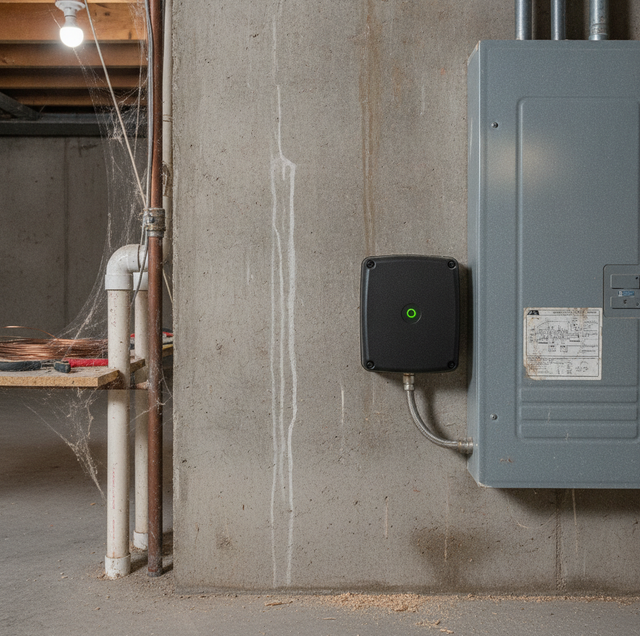
A whole-house SPD is installed at the electrical panel, wired in by a licensed electrician, and it sits watching the incoming power for the whole home at once. When voltage jumps past a safe threshold, the device clamps it, diverting the excess energy so the spike is knocked down before it can travel out onto the branch circuits. Because it sits upstream of everything, it protects the things you cannot plug into a strip: the HVAC system, the built-in appliances, the LED lighting circuits, the hardwired smoke alarms, and the water heater controls. A plug strip can do nothing for any of those, since they are wired directly and never pass through an outlet you can reach.
A lock on the front door of the house guards more than a lock on any single interior room does. The panel SPD is that front-door lock. It handles the big arrivals at the point where power enters, so a single device covers every circuit at once instead of you trying to guard each outlet separately.
Joules, Lifespan, And The Indicator Light
An SPD works by absorbing surge energy, and it sacrifices a little of itself each time it does. That is why every unit carries a joule rating, which is roughly how much surge energy it can absorb over its service life before it is depleted. A higher joule rating means it can take more surges, or bigger ones, before it reaches the end. It is a consumable part, not a permanent fixture, and it will eventually wear out even when nothing has visibly gone wrong. Many units include an indicator light for exactly this reason: while the light shows the protective components are still intact, the device is doing its job, and when it goes dark or changes, that is the signal to have it replaced. Checking that light now and then is the whole of the maintenance.
Layered Protection: Why You Still Want Plug-In Devices
A whole-house SPD is the first line, not the only line. A surge does not always get clamped to zero. A little of it can pass through, and for most appliances, that remainder is harmless. For the most sensitive electronics, a second layer is worth having.
First Line And Last Defense
The panel device suppresses large surges before they spread. Point-of-use protection, a good plug strip, or an uninterruptible power supply with a battery, sits right at the computer, the television, the network gear, or the home theater and catches the smaller remainder that slips past. The two are not competitors. They are stages of the same defense, and sensitive electronics get the benefit of both: the panel handles the heavy hits, the plug-in device mops up what is left at the outlet. A battery backup adds one more thing a strip cannot, riding through the brief dips and outages that follow many surges, so a desktop does not lose whatever was open.
Who Benefits Most From Whole-House Protection
Every home takes internal surge wear, so every home gains something. The homes that gain the most share a couple of traits.
The first is simply having a lot to protect. A house full of electronics, LED lighting throughout, smart-home devices on many circuits, and costly appliances has more value exposed to voltage spikes, and the LED drivers and smart controls happen to be among the most surge-sensitive things in a modern home. The second is the surge environment itself. Homes in areas with frequent storms, or served by an older or unstable utility supply that switches and sags, simply see more and larger external surges. When both traits line up, more to protect and more surges to protect against, the case is strongest.
A Note on Safety
The panel is not a homeowner project. The line side of an electrical panel stays energized even with the main breaker off, and the terminals carry enough current to be lethal. Installing an SPD means working inside that panel, which is licensed electrician work by law and by good sense. Never open the panel to attempt this yourself. The device itself is inexpensive relative to what it guards, but the value comes from it being sized and wired correctly, and that is the electrician's job.
Frequently Asked Questions
Not mainly from lightning, as most people assume, but from inside the home. Large motors in the air conditioner, the refrigerator, and well or sump pumps create a small surge every time they cycle on and off, and those cycle dozens of times a day. Each of those spikes is absorbed by the sacrificial part inside most surge devices, a metal-oxide varistor, or MOV, that wears down a little with every hit. That is why a unit eventually needs replacing, even though the wear itself is invisible.
A whole-house device is installed at the electrical panel and clamps a surge before it reaches any circuit, protecting hardwired devices that a strip never reaches: the HVAC system, built-in appliances, and LED lighting. A panel unit is a Type 2 surge protective device, installed on the load side of the main breaker; a Type 1 mounts ahead of the main breaker instead. A plug strip is point-of-use only, meaning anything wired directly into the house is on its own unless the protection sits up at the panel.
Yes, because the two work as layers rather than substitutes. The panel device clamps the big surge but still passes a smaller residual voltage downstream, which the industry calls the let-through. A point-of-use strip or battery backup at a computer or television catches that let-through remainder right at the sensitive device. Sensitive electronics get both stages that way, which is more than either device provides alone.
It does. A surge protective device absorbs energy and sacrifices a little of itself during many surges, so it has a limited lifespan, measured in part by its joule rating. Many units carry an indicator light that turns off or changes color once the device has worn out, which is the cue to replace it. A whole-house unit wires to its own dedicated double-pole breaker in the panel, and the shorter its leads run, the better it clamps, which is one reason it is a professional install rather than a swap you do yourself.
The joule rating is roughly how much surge energy the device can absorb over its lifetime, so a higher number means more or larger surges before it is used up. But joules are only half the picture: the clamping, or let-through, voltage rating tells you how low the device holds the residual spike, and that matters just as much for how well it protects. An electrician compares both specs against how much electronics the house runs and how rough the local power supply tends to be, not joules alone.
Homes with a lot of electronics, LED lighting, smart-home devices, and costly appliances gain the most, since they have the most value exposed to voltage spikes. Homes with well pumps, large HVAC equipment, or a shop full of motors are their own second reason: those motors generate more internal surges, so those homes benefit even in a mild climate that rarely sees storms. When a home has both more to protect and more surges of its own, whole-house protection earns its place most clearly.
Book a licensed electrician to size and install panel surge protection — protect your HVAC, appliances, and electronics before the next spike. Wired Up Electrical serves Lynchburg, Forest, and Bedford. Call (434) 254-1264.
