
Why Is Half My Room Suddenly Without Power?
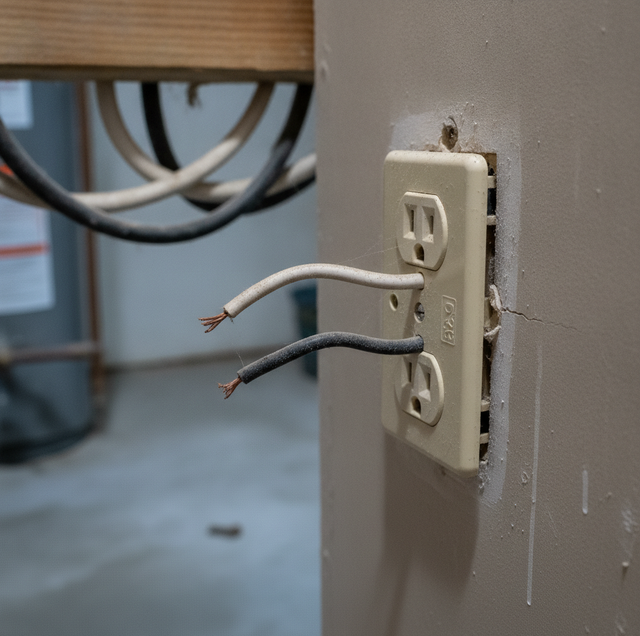
Half a room can go dark for a reason that has nothing to do with the panel. You plug in a lamp, get nothing, try the next outlet, and it is dead too, yet every breaker in the box looks perfectly normal. When a partial outage shows up with no tripped breaker, the power is being cut somewhere along the circuit instead of at the panel, and the list of things that do that is short. One of them takes about a minute to rule out, and the rest are worth understanding before you decide whether to keep poking or pick up the phone.
Why Power Stops Along The Circuit Instead Of At The Panel
A breaker protects the whole run. When it trips, it kills every outlet on that circuit at once and shows a flipped switch in the panel. A partial outage behaves differently on purpose: the power reaches the panel fine and travels partway down the circuit before something stops it. Outlets on a circuit are usually wired one after another, so a break at any single point cuts everything past it, while the outlets ahead of it keep working, and the breaker stays on.
That narrows the possibilities to a handful. A tripped GFCI can shut off everything wired downstream of it. An outlet may be controlled by a wall switch you did not realize was off. Or a connection somewhere in the run has worked loose or failed. Sorting through them in order, from the one-minute fix to the one that needs an electrician, almost always lands on the answer.
Work Through It In Order
Start with the checks you can safely do yourself, and stop the moment the trail leads inside the wiring.
- Reset every GFCI in the house, not just the room that is dark: A GFCI is the outlet with the small test and reset buttons. It protects itself and any ordinary outlets wired downstream of it, so a single tripped GFCI can take out outlets in a room that has no reset button of its own. The one that tripped is often somewhere you would not think to look, a bathroom, the kitchen counter, the garage, or an exterior outlet by the patio. Press reset on each and check whether the outlets come back to life.
- Check for a wall switch that feeds the outlet: In many rooms, one or both halves of certain outlets are switched, meant for a lamp you turn on at the door. If only some receptacles are dead and flipping a nearby wall switch brings them back, nothing is broken at all. This is worth ruling out before you assume the worst.
- If neither of those, does it, treat it as a wiring connection and call a pro: Once GFCIs and switches are ruled out, the outage is coming from a loose or failed connection inside a box, and that is the point to stop. Diagnosing it means opening boxes and testing live wiring, which is an electrician's job, not a homeowner's.
What A Failed Connection Actually Looks Like
Behind the wall, an outage that survives the GFCI and switch checks usually traces to one bad joint. A common culprit is a back-stab connection, where the wires were pushed into the small spring-loaded holes on the back of a receptacle instead of being clamped under the side screw terminals. Back-stabs rely on a thin metal tab for contact, and that grip weakens over the years of heating and cooling. When it lets go, the outlet still sits in the wall looking normal, but every outlet downstream of it goes dead.
A tired screw terminal or a wire nut that was never twisted down tightly does the same thing. Any of these can interrupt the run without the breaker noticing, because a loose joint is not the same as a short or an overload. The panel only sees a problem when too much current flows, and a failing connection often carries less, not more.
The reason a pro takes this seriously is heat. A loose connection adds resistance, resistance turns electrical flow into warmth right at the joint, and that warmth builds up inside a closed box against wood and insulation. A dead outlet is the inconvenience you notice; the heat you cannot see is the actual hazard. Warmth at a faceplate, a faint scorched smell, or brown discoloration around a receptacle all mean the same thing, and none of them should wait.
Older Homes And Aged Connections
Partial outages are more common in homes that have been wired for decades, and the reason is simple wear. Every connection made years ago has been heating and cooling with each use since, and back-stabs and hand-tightened joints loosen a little more with every cycle. Aluminum branch wiring from certain eras adds its own tendency to work loose at terminals. Older and historic houses carry a lot of this original work, sometimes layered under later additions, so a half-dark room in an older home is often an aging connection announcing itself. Catching it after the GFCI reset comes up empty is the difference between a quiet repair and a connection that keeps heating in the dark.
Frequently Asked Questions
Map it deliberately instead of guessing. With the outlets still dead, press the test button on one GFCI at a time and watch what changes; the outlet that clicks off along with it is on that GFCI's protected chain, and pressing reset brings the group back. A quicker version: plug a cheap plug-in outlet tester or a lamp into the dead receptacle, then walk to each GFCI and trip it, noting when your tester loses power. Do this once and label the GFCI faceplate with the rooms it covers, so the next time an outlet dies, you know exactly which reset button to hit rather than circling the whole house.
Yes. Builders often wire the top or bottom half of a receptacle to a wall switch so a lamp can be controlled from the doorway, and the other half stays always-on. If a plugged-in lamp is dead but a phone charger in the same outlet works, you are likely looking at a half-hot switched receptacle, and the fix is finding the switch that feeds it. It is worth flipping every nearby switch before assuming a fault.
The difference is in the contact area and clamping force. A back-stab holds the wire against a thin spring tab at a single point, while a screw terminal wraps the wire two-thirds of the way around the post and clamps it under real pressure, so it spreads current across far more metal and stays tight through years of heating and cooling. When an electrician finds a failed back-stab, the repair is to release the wire from the stab hole, cut back any nicked or darkened copper to bright wire, form a fresh clockwise hook, and land it under the side screw torqued to spec. On heavier-gauge or crowded circuits, they may instead pigtail the wires with a rated connector and run one lead to the device, which entirely removes the pass-through current load from the outlet.
It can. The neutral wire is the return path, and if it works loose at a shared connection, outlets may behave strangely rather than simply going dead: lights that dim and brighten, electronics that misbehave, or some devices working while others on the same circuit do not. A loose or "floating" neutral can also let voltage climb on part of the circuit, which is hard on plugged-in electronics. Odd, inconsistent symptoms like these are a reason to have the wiring checked rather than lived with.
It is a slow heat problem, not a sudden spark. A poor contact behaves like a small resistor in the circuit, and every time current passes, that resistance converts a little electricity into heat right at the joint. The danger is that this can keep worsening on its own: heat oxidizes the copper, the oxide layer adds more resistance, and the extra resistance makes more heat, a runaway loop that a breaker never sees because the current stays within its rating. Given enough cycles, the hot spot can carbonize the surrounding plastic and wood into a conductive char that eventually ignites. A standard breaker only reacts to overload or short circuit, so it offers no protection against a joint that is quietly cooking; that gap is exactly what makes an unseen loose connection worth taking seriously.
Go in this sequence and let go when it stops working. First, reset every GFCI in the house, pressing firmly until the button latches; if one will not stay reset, that is a signal in itself, not a stubborn button. Next cycle, the suspected breaker is turned all the way off and then back on, since a breaker can sit in a partly tripped middle position that looks on but is not passing power. Then flip each nearby wall switch in case a receptacle is switched. If the outlets are still dead after all three, stop, because what remains is inside the wiring. Call an electrician the moment a reset will not hold, an outlet keeps knocking out an AFCI or GFCI, you notice lights flickering or dimming across the circuit (a hint of an open neutral), or you smell burning or feel heat at a faceplate. Those belong to a pro with the power isolated, not to opening a live box.
Putting The Pieces Together
A half-dark room with no tripped breaker almost always means the power is being interrupted along the circuit rather than at the panel. Reset every GFCI first, including the ones in other rooms, because that clears many cases in under a minute. Check whether a wall switch feeds the dead outlets. If both come up empty, what is left is a connection problem inside the wiring, the kind that can heat up out of sight, and that is exactly the situation worth handing to someone who can open it up safely.
If resetting the GFCIs and checking the switches doesn't bring your outlets back, we'll track down the fault and make it safe. Wired Up Electrical serves Lynchburg, Forest, and Bedford. Call (434) 254-1264.
