
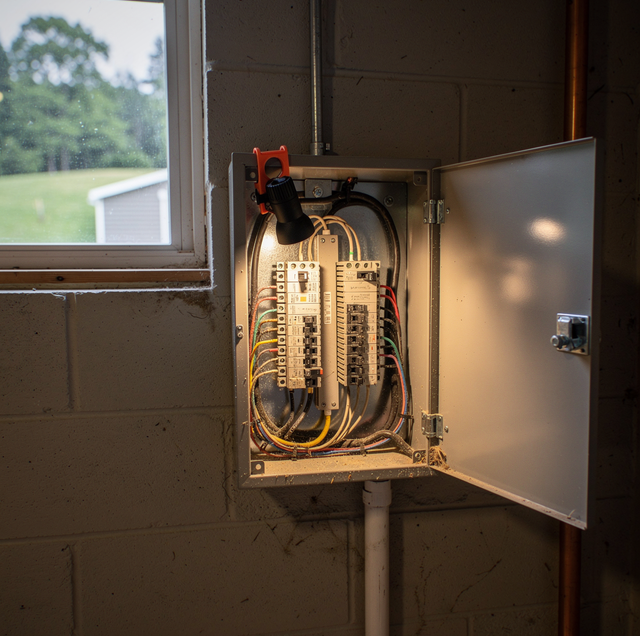
An electrical safety inspection is a planned walk-through of a home's wiring with one purpose: to find the conditions that lead to shock, overheating, or fire while they are still visible defects and before they fail. A licensed electrician works from the point where power enters the house to the last outdoor receptacle and records what needs attention and how soon. The inspection has limits worth knowing at the start. It is a private assessment for the owner, so it carries no permit, and a jurisdiction's inspection of permitted electrical work is a separate event run by a different office.
The walk-through follows the path the power takes. Each area on that path is matched with what the electrician examines there:
| Area | What gets looked at |
|---|---|
| Service entrance and meter base | Mast and weatherhead secured, cable jacket intact, no rust or water entry |
| Main panel and breakers | Breaker size against wire size, scorching, double taps, open slots, labeling |
| Grounding and bonding | Electrode conductor and clamps, bonds to water and gas piping, subpanel bars |
| Receptacles, GFCI and AFCI | Polarity, ground path, worn contacts, test buttons that trip |
| Visible wiring in attic, basement and garage | Cable support, damaged sheathing, splices outside boxes, missing covers |
| Fixtures and switches | Heat discoloration, loose mounting, warm switches and dimmers |
| Outdoor and wet locations | Covers that close over a cord, weather-resistant receptacles, cracked conduit |
The Service Entrance and Main Panel
Power arrives either overhead, via a drop that lands on a mast and weatherhead at the roofline, or underground, via a lateral that rises to the meter base. A mast pulled away from the wall, a split in the service cable's jacket, or rust streaks below the meter base are signs that water has reached connections carrying the full service current. The meter belongs to the power company, and the overhead drop may belong to it as well, so damage on that side is reported as an item for the utility.
Inside, the main panel is where the inspection starts in earnest. With the inner cover off, each breaker is compared against the wire it protects. A breaker is designed to trip before its wire overheats, and that works only when the breaker's rating stays within the wire's capacity. A breaker larger than the wire it protects allows that wire to carry current beyond its rating without ever tripping, and nothing in daily use reveals the mismatch.
The same pass covers double taps, where two wires share a terminal built for one and either can work loose; darkened or melted insulation near a terminal; water staining inside the enclosure; and open slots in the cover where a breaker was removed and no filler plate went back in, leaving live parts within reach of a finger. The panel's make, model, and rating get recorded, along with whether the directory is legible. Whether the findings warrant a panel replacement is a decision made afterward, with the report in hand.
Leave the panel cover and every outlet, switch and junction box closed. The wires feeding the main breaker remain energized even when it's switched off, so opening them is a licensed electrician's work. Stop using anything warm, buzzing, or scorched and call.
Grounding and Bonding
Grounding and bonding are separate jobs that get confused because they share hardware. Grounding connects the system to the earth through the grounding electrode conductor, the heavy bare or green wire that leaves the panel and clamps to a ground rod beside the foundation, to a metal water pipe where it enters the house, or to both. Bonding ties metal systems that could become energized, such as water and gas piping, back to the same point, so a fault cannot leave one pipe at a dangerous voltage relative to another.
The inspection follows that conductor as far as it can be seen. A corroded clamp, a conductor cut during a plumbing repair, or a rod connection buried under a new patio each breaks the path. When a metal water line has been partly replaced with plastic, a pipe that once served as a grounding connection can end up isolated, and the electrician notes whether a jumper carries the bond across the gap.
In a home's electrical service, neutral and ground are joined at one point: the main service disconnect. A subpanel keeps them on separate bars. When a subpanel has neutrals and grounds mixed on one bar, normal return current can flow through grounding wires and metal parts that were never meant to carry it. That condition produces no symptoms anyone in the house would notice, so it only shows up when someone opens the subpanel to look.
Receptacles and Protection Devices
Receptacles get a room-by-room check with a plug-in tester, which reads whether hot and neutral are reversed and whether a ground path is present. Reversed polarity leaves the threaded shell of a lamp socket energized, where a finger changing a bulb can touch it. A three-slot receptacle with no ground behind it looks protected while giving plugged-in equipment no fault path at all. The tester has one blind spot: a bootleg ground, where someone jumpered the ground terminal to the neutral, reads as correct, so a suspicious result elsewhere on that circuit sends the electrician into the box. A receptacle that no longer grips a plug is noted too, because worn contacts heat up under load.
A GFCI cuts power in the event of a current leak to ground, and its test button should shut the receptacle off when pressed. An AFCI watches a circuit for the signature of arcing and is checked for presence and a working test function. Wet locations without GFCI protection are reported as findings because the shock risk exists regardless of the house's age. Bedrooms and living areas wired before arc-fault protection existed go on it as an upgrade to consider.
Wiring You Can See in the Attic, Basement and Garage
In an attic, basement, crawl space or garage, the electrician looks for cable hanging loose off the framing; sheathing crushed under a staple, gnawed or cut; and cable run across the bottom edge of joists, where stored boxes can reach it.
Splices get their own check on this part of the list. Every connection between two wires belongs inside a box with a cover, because a loose splice can arc, and the box contains the heat and sparks. A twist of wire and tape stuffed into insulation between joists has none of that containment. Junction boxes missing covers, boxes buried behind drywall, and extension cords stapled along a wall as permanent wiring go on the report for the same reason.
This is also where the wiring method gets identified, since the type of cable and its apparent age frame every other finding. The warning signs that prompt a call are what bring an owner to this point; the walk-through looks past them to conditions that give no signal at all.
Fixtures, Switches, Alarms and Outdoor Equipment
Fixtures and switches get a look for discoloration on the plate or canopy, loose mounting, and switches or dimmers that feel warm under a normal load. A dimmer with more lighting than its rating on the strap is noted.
Hardwired smoke and carbon monoxide alarms are part of the electrical system even though they warn about fire and gas. They run on a branch circuit with battery backup, and on a wire-interconnected system, a signal wire links them so one alarm sounds all of them. The inspection checks that each unit has power, that pressing the test button on one sets off the rest, and the manufacture date printed on each unit.
Outside, the list turns to water. Wet-location receptacles are checked for covers that stay closed when a cord is plugged in, and weather-resistant receptacles bear that marking on their face. Cracked conduit, separated fittings, and exterior fixtures with failed gaskets give water a route to live parts. The disconnect beside an air conditioner gets checked for a cover that closes and an enclosure that has not rusted through.
How the Report Ranks What Was Found
Findings are grouped by urgency so an owner knows where to start.
Hazard now: Conditions that can hurt someone or start a fire without further change, such as exposed live parts in an open panel slot, a scorched terminal, or a wet-location receptacle without shock protection. A scorched terminal's circuit stays off until repaired.
Repair soon: Defects that are not an emergency today but could become one over time or with added load, such as a double-tapped breaker, a loose receptacle, a corroded ground clamp, or a junction box without a cover.
Upgrade to consider: Items that met the standard the house was built to but fall short of current protection standards, such as arc-fault protection on bedroom circuits, a whole-home surge protector at the panel, or additional kitchen circuits.
Each finding includes its location and what was observed, so the report supports repair planning, a home sale, or an insurer's inquiry.
When an Inspection Makes Sense
Buying a home: Finding a double tap or a subpanel with mixed neutrals before closing puts it into the negotiation instead of onto the new owner's list.
An older house: Decades of additions by different hands are one source of mismatched breakers, open splices, and cords serving as wiring.
After a surge or water exposure: A surge that damaged electronics can also damage receptacles, dimmers and appliance controls. Breakers, receptacles, and sheathed cable that have been underwater are replaced rather than dried and reused, because water leaves corrosion inside parts that cannot be cleaned.
Before a large addition or a new heavy load: An inspection shows whether the existing system is sound enough to extend, a separate question from how much capacity the new work needs.
After unknown work by a previous owner: Circuits nobody can account for, or a directory that no longer matches the rooms, leave the wiring's condition a guess until someone walks it.
Frequently Asked Questions
Parts of it can. Switching individual breakers off lets the electrician confirm which lights and receptacles each circuit feeds and bring a drifted directory back into line. Expect clocks and routers to need resetting afterward, and clear stored items away from the front of the panel so a person can stand square to it.
Not necessarily. The test button confirms the horn and the unit's circuit work, and says nothing about the sensor's age. Smoke alarms are due for replacement ten years from the manufacture date printed on the back, whether or not they still sound, and a replacement has to match the existing interconnect wiring for the set to keep sounding together.
No. A home inspector surveys the roof, plumbing, structure, and wiring in one visit and writes up what can be seen. When an electrical item requires more than a visual inspection, the report can recommend further evaluation by a licensed electrician. An electrical safety inspection is that evaluation, carried out by the trade that would make the repair.
Partly. A thermal camera, when used, can show a hot connection behind a cover plate or inside a panel, but only while that circuit carries current, so a lightly used circuit can look cool even with a loose connection. Cable running through a closed wall with no box nearby stays out of reach unless the wall is opened.
It can, and it has details of its own. The feeder from the house is checked for four wires: two hots, a neutral, and a separate ground, kept apart in the outbuilding's panel, and for the outbuilding's own grounding electrode, such as a ground rod beside it. Older three-wire feeders are noted so the owner knows which arrangement is in place.
Yes. The nameplate on the outdoor unit lists two figures: the minimum circuit ampacity, which sets the smallest wire size the circuit can use, and the maximum overcurrent protection, which caps the breaker size. A breaker above that maximum is a finding even if the unit runs normally, because the unit's wiring is then left without the protection it was rated for.
Arrange an electrical safety inspection — every area from the meter base to the outdoor receptacles is checked, and each finding is ranked by urgency. Wired Up Electrical serves Lynchburg, Forest, and Bedford. Call (434) 254-1264.