
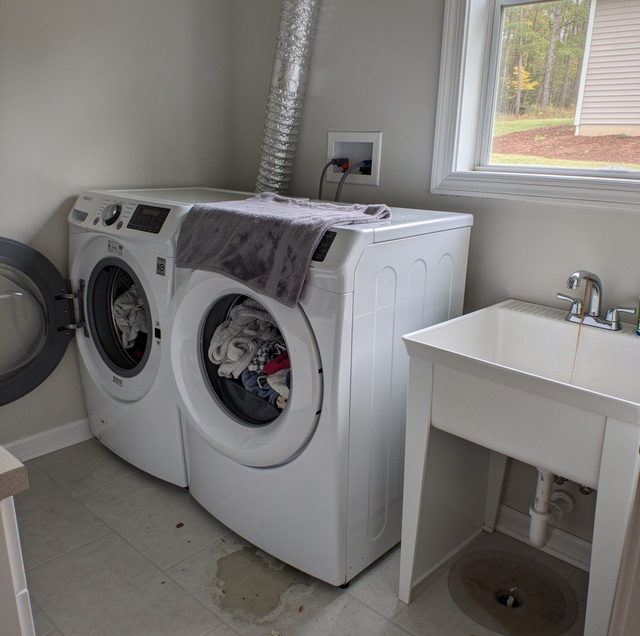
A laundry room collects moisture and heat from several sources. The washer finishes each cycle with a drum of warm, wet clothes, and when the lid or door opens, that damp air spills into the room. A dryer's cabinet gives off heat while it runs, and the joint where its vent hose meets the wall collar can leak a little warm, lint-laden air if the connection has loosened. Clothes hung to dry on a rack or a line release all of their water into the room air, and a utility sink adds standing water and vapor. The dryer's own vent handles one of those sources and nothing else: it carries the dryer's exhaust outdoors while the machine is running. A room exhaust fan has a different job: to pull the whole room's air out and replace it, whatever produced the moisture in it. Whether your room needs that second job depends on how it is built and used, as the situations in this table show.
| Room situation | What gets trapped | What it means for a fan |
|---|---|---|
| Closet laundry behind louvered doors | Heat and damp air pass through the louvers into the hallway or living space | Depends on how tightly the closet sits against living space; louvers move air but do not remove it from the house |
| Enclosed room with no window | Everything the washer, dryer, and sink release, with no exchange path | A strong case for a fan, since the room has no direct path to outdoor air |
| Basement or utility room | Damp air meeting cool masonry walls and cold pipes | Worth adding where condensation already forms on those surfaces |
| Room that also line-dries clothes | The full water content of each hung load | Worth adding, because that moisture has nowhere to go but the room |
| Room sharing a wall with a bedroom | Moisture and machine heat beside a sleeping space | A fan helps, and quiet mounting becomes part of the decision |
| Mildew or a musty smell keeps returning | Moisture held in drywall, paint and framing behind the machines | Cleaning removes the growth but not the source, so ventilation is the fix to weigh |
Dryer Vent and Room Fan Do Two Separate Jobs
The dryer vent is a closed pipe with one purpose. It starts at the back of the dryer, runs through a wall or ceiling, and ends at an exterior hood. The dryer's own blower pushes hot, humid, lint-carrying air through it only while a load is tumbling. The vent does nothing for the steam that left the washer, the water evaporating from a drying rack, or the warm air lingering in the room after the last load.
A room exhaust fan works on the room itself. It sits in the ceiling or high on a wall, draws air from the whole space, and sends it out through its own duct. The dryer vent is never tied into the fan duct and never vented into the room, because lint and the dryer's moisture load would clog the fan duct and soak the room it is meant to dry.
Lint is also why the dryer vent deserves attention in its own right. Lint that builds up inside a dryer vent is a fire risk, and a vent that is kinked, crushed behind the machine or packed with lint is cleared rather than ignored. A blocked dryer vent can also leave a room damp enough that a fan gets blamed for a problem it never caused.
Signs the Room Is Holding Moisture
Trapped moisture shows on the room's surfaces before anything smells wrong.
Condensation on the window or pipes: Beads of water forming on the inside of the window glass or on cold water supply lines and the washer's cold inlet hose mean the room air is carrying enough moisture to condense on anything cooler than itself.
A musty smell: A smell that stays in the room after the laundry is put away, rather than fading with the last load, can come from moisture that has settled into porous materials and stayed there.
Mildew behind the machines: The wall strip behind a washer and dryer sits outside the path of moving air. Dark spotting there, on the baseboard or on the back of the machines themselves, marks the place where damp air comes to rest.
Blistering or peeling ceiling paint: Warm, damp air rises, and the ceiling is where it first meets the paint film. Bubbles or flaking in the ceiling paint, especially above the washer or a drying area, show moisture getting behind the paint rather than leaving the room.
One of these after a single heavy wash day says little. Two or three that keep returning say moisture is staying in the room, from a ventilation shortfall or a dryer vent not doing its job.
Condensation dripping from a cold water line can leave a damp patch under the washer that looks like a leaking hose. A dry hose connection under a beaded, dripping pipe can mean room moisture rather than a plumbing fault.
When the Decision Is Close
Some rooms sit on the line. A laundry area with an operable window, a small closet that opens onto a large, open hallway, or a room used for one load a week may never show any of those signs, and a fan there adds little. A room that shows two or three of those signs, or one that is fully enclosed and in use several times a week, is a different case, and a fan there gives that moisture a way out.
How the space is used also decides it. The same room can stay dry for a household that moves each load to the dryer when the wash ends, and stay damp for one that line-dries every load and leaves wet loads sitting in the washer.
Whether a particular laundry room requires mechanical ventilation at all is something the local authority and the electrician will confirm for your house. That answer depends on the room's use, its windows, and its location in the building.
Fan Capacity and Placement Follow the Air Path
A fan can only pull out air that has a way to come in. Every cubic foot the fan sends outdoors must be replaced, and in a laundry room, that replacement air enters through openings such as the gap under the door, louvers, or an open doorway. With every entry closed off, the fan spins against a sealed room and moves little air.
That air path sets the placement. The fan belongs on the opposite side of the room from where the air enters, near the moisture sources, so the incoming air sweeps across the washer, the sink, and any drying area on its way out. A fan mounted right beside the door draws the incoming air straight back out, leaving the corners where the moisture sits untouched. Above the washer, or where clothes hang, fits that logic.
Capacity follows from the room's size, the moisture load, and the length and route of the duct run, and is calculated as part of a ventilation assessment rather than guessed from the fan box. An undersized fan can run and run without clearing the room. Secure mounting and correct duct connections matter for noise as well, because a housing loose in its framing or a poorly joined duct rattles and hums through the ceiling, which matters beside a bedroom.
Ducting Has to Finish Outdoors
Where the fan's duct ends decides whether the fan solves anything. The duct runs to the outside, ending at an exterior wall cap or a roof cap.
A duct that ends in the attic sends warm, wet air straight onto the insulation and the underside of the roof deck. The moisture condenses on the coolest surfaces it finds, and the result can be damp insulation, stained sheathing, and mold growth. A duct that ends inside a wall cavity does the same thing out of sight, loading the framing and the back of the drywall with the moisture the fan was meant to remove.
The route between the fan and the exterior matters too. Each bend and each length of duct adds resistance the fan pushes against, and a flexible duct that sags between joists creates a low point where condensed moisture can gather. A short, well-supported run with tight joints lets the fan deliver the airflow it was chosen for.
Wiring and Control for a Laundry Fan
The control decides whether the fan runs when the moisture is there.
A wall switch: The fan runs while the switch is on. It depends on someone remembering to leave it on long enough.
A timer: The fan runs for a set period after it is switched on, then stops on its own, so the room keeps clearing after you leave.
A humidity-sensing control: The fan starts when the room's humidity rises above a set point and shuts off when it drops back below, with no one needing to touch it. In a room where a drying rack releases moisture long after anyone was there, this option follows the moisture instead of the occupant.
The circuit behind any of these is the electrician's call: whether an existing circuit can take the fan and how the switch and fan boxes are fed are decisions for a licensed electrician, and wiring a new fan circuit or a new box is not a do-it-yourself job. Before any fan, grille, or cover is touched, even to clean it, the power is turned off at the breaker.
A laundry fan that runs hot, hums without spinning, or gives off a burning smell can overheat its motor and start a fire. Switch the fan off at the breaker, then have an electrician remove it and trace the fault.
Frequently Asked Questions
It can in a tight room. A fan pulling air out of a room with no easy way for air to get back in lowers the pressure there, and a gas water heater or furnace with an atmospheric vent can then draw its combustion gases back down the flue into the room. That is called backdrafting, and it is one reason a utility room holding fuel-burning equipment needs a clear makeup-air path and a working carbon monoxide alarm.
A window helps only while it is open, and it moves air only when there is a breeze or a pressure difference to drive it. A fan exhausts air with the window shut, at night and on days when leaving a window open is not practical.
A soffit ending is a poor choice even though it is technically outdoors. The soffit vents under the overhang pull outside air into the attic, and warm, damp air released next to them can be drawn straight back up into the attic space it was meant to stay out of. A wall cap or roof cap with a backdraft damper keeps the exhaust away from those intakes and stops outdoor air flowing back down the duct.
Where the duct runs through an unconditioned attic, insulated duct is the right choice. Warm, moist air moving through a bare duct in a cold attic condenses on the inside wall of the duct, and that water can run back toward the fan and drip out of the grille onto the laundry room floor. Insulation keeps the duct surface warm enough that the moisture stays in the air until it leaves the house.
It can, particularly with a front-loading washer. The rubber door gasket on a front loader holds water and lint in its folds after each cycle, and mildew growing there produces the same musty smell as a damp room. Wiping the gasket dry and leaving the door ajar between loads can help stop the washer's smell. If the smell persists, the room or the drain the washer empties into is the next place to look.
It can. Every cubic foot of air the fan exhausts is replaced by air drawn in from the rest of the house, air that the heating or cooling system has already brought to temperature. A fan left running around the clock sends that conditioned air outdoors, which is why a control that stops the fan once the room is dry saves energy compared with a fan that is never switched off.
Set up laundry room exhaust fan installation — fan capacity and placement, the wiring, and a duct run to the outdoors. Wired Up Electrical serves Lynchburg, Forest, and Bedford. Call (434) 254-1264.