
How a Standby Generator Keeps Your Home Powered When the Grid Fails
The moment utility power drops, a well-installed standby generator has your home back on before you have finished reaching for a flashlight. There is no cord to drag out, no pull-start, no fumbling in the dark. The house keeps running. To most people, that looks like magic, but it is a specific sequence of events happening in a specific order, and understanding that sequence tells you a great deal about what a standby generator actually is and why it has to be installed the way it is.
A standby generator, sometimes called a whole-home generator, is a permanently installed unit that sits outside the house, much like an air-conditioning condenser. It is wired directly into the home's electrical system, and it runs on a fixed fuel supply. It is not a machine you set up when a storm is coming. It waits, self-tests, and stands ready around the clock so that when the grid fails, the response is automatic.
What Actually Happens When the Power Goes Out
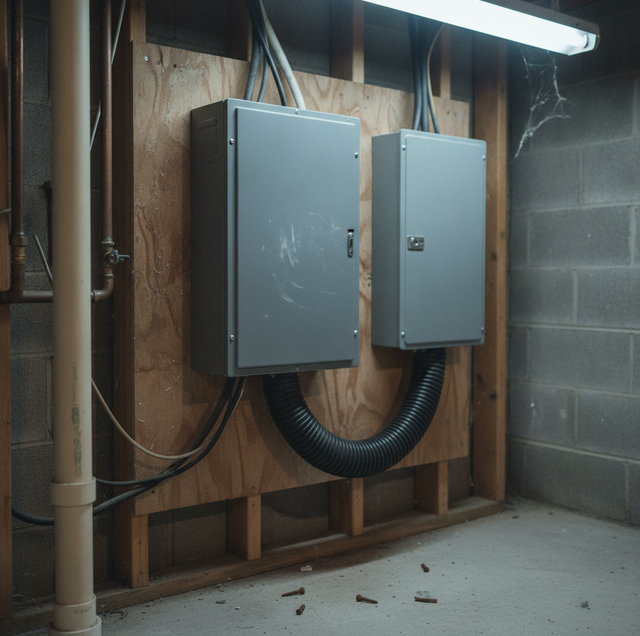
The device doing the real work here is not the generator itself. It is a component called the automatic transfer switch, usually shortened to ATS. Think of the transfer switch as a traffic controller standing between two roads: the utility line coming from the pole, and the generator sitting in the yard. Only one road is ever allowed to feed the house at a time, and the transfer switch is what decides which one.
Under normal conditions, the transfer switch keeps the house connected to the utility and the generator idle. It constantly monitors the incoming voltage from the grid. The instant that voltage drops or disappears, a chain of events begins.
First, the transfer switch physically disconnects the house from the utility line. This is not a minor detail; it is the single most important safety function in the whole system, and we will come back to why. Second, the switch sends a start signal to the generator. The generator's engine cranks and fires on its fuel supply, comes up to speed, and begins producing stable power, usually within seconds. Third, once the generator is producing clean electricity, the transfer switch connects it to the home's circuits. The house comes back to life.
When utility power returns, the sequence runs in reverse. The transfer switch senses that the grid is stable again, disconnects the generator, reconnects the house to the utility, and signals the generator to cool down and shut off. It goes back to standing by. Nobody has to be home. Nobody has to touch anything.
Why the Transfer Switch Is the Heart of the System
It is tempting to think of the generator as the star of the show, but the transfer switch is what makes a permanent installation safe and legal. The reason comes down to a hazard called backfeed.
If a generator were simply connected to the home's wiring while the house was still tied to the grid, the electricity it produces would not stay inside your walls. It would flow back out through the service line, onto the utility lines outside, and down the street. A utility crew working to restore power assumes those lines are dead. Backfed current can energize them without warning and can injure or kill a lineworker. It can also feed power into your own equipment in ways it was never meant to handle.
The transfer switch prevents this by making it physically impossible for the generator and the utility to be connected to the house at the same time. It isolates your home from the grid before it ever lets the generator take over. That is why a standby generator is not a plug-in appliance and never a do-it-yourself weekend project. It is a permitted installation performed by a licensed electrician, inspected to confirm the isolation works exactly as intended.
Whole House or Just the Essentials
Not every standby generator is sized to run everything at once, and it does not need to be. How much of your home a unit can carry depends on its output, which is rated in kilowatts, or kW.
A larger unit can be sized to power the entire house, so life during an outage looks no different from an ordinary day. A more modestly sized unit is wired to a set of essential circuits chosen ahead of time. Those essentials typically include heating and cooling, the refrigerator and freezer, a well pump if your water depends on one, medical equipment such as an oxygen concentrator or CPAP, and a handful of outlets and lighting circuits. The transfer switch is configured to feed only those circuits, which keeps the load within what the generator can comfortably supply.
The right size is a matter of adding up what you actually want to keep running and matching it to a unit rated for that load, with margin to spare. An electrician does this calculation as part of the design because an undersized generator that is asked to carry too much will struggle, and an oversized one is money spent on capacity you will never use.
Fuel: Natural Gas Versus Propane
A standby generator runs on one of two fuels, and the choice shapes how long it can keep going.
Natural gas is piped in from the utility, the same line that might feed a furnace or a range. Its great advantage is runtime. Because the fuel arrives continuously through the pipe, a natural-gas standby unit can run for days on end without anyone refueling it, for as long as the gas supply itself holds. For a long, multi-day outage, that is hard to beat.
Propane is stored in a tank on the property. It burns cleanly and is a common choice for homes that do not have a natural-gas line, which describes a lot of rural properties. The tradeoff is that runtime is bounded by tank size. A larger tank buys more days; a smaller one buys fewer. You are running on the fuel you have stored, so planning tank capacity to match how long your typical outages last is part of the decision.
Neither fuel is universally better. Natural gas offers effectively unlimited runtime where a line is available. Propane offers independence from the gas utility at the cost of finite storage. Which one fits depends on what is already at your house.
An Evergreen Case for Backup Power
It is easy to picture standby generators as a response to one dramatic kind of event, the big regional storm that knocks out power for a week. Those certainly happen, and storm systems are a real driver of outages in many areas. But framing backup power as a storm-season purchase misses most of the picture.
Outages are not seasonal. A summer heat wave strains the grid and triggers rolling interruptions. Winter ice loads down lines and snaps limbs onto them. A car hits a pole in spring, a substation fault knocks out a neighborhood in fall, and aging equipment fails on a clear day in any month. If your household includes someone who depends on powered medical equipment, or a well pump that is the only source of water, or a finished basement that floods without a sump pump, the calendar does not matter. The value of a standby generator is that it answers every one of those situations the same way, automatically, whenever they occur.
How a Standby Differs From the Portable in Your Garage
Many homeowners already own a portable generator, and it is worth being clear about how different the two really are, because the differences are not just about size.
A portable generator is a manual machine. When the power goes out, someone has to roll it out of storage, place it well away from the house, start it, and connect it. That connection is where safety matters most. A portable should never be plugged into a wall outlet to power the house, because that creates the exact backfeed hazard described earlier. The safe way to connect one to home circuits is through a manual transfer switch or an interlock kit installed at the panel by an electrician, which prevents the generator and utility from ever being live together. Anything less means running extension cords to individual appliances.
A portable also has to be refueled by hand, usually every several hours, which means someone getting up in the night during a long outage. And critically, it must run outdoors, well away from windows and doors, because its exhaust contains carbon monoxide. A standby unit, by contrast, is permanently placed and vented for safe operation, starts on its own, runs on a fixed fuel line, and needs no one present. One is a tool you operate. The other is a system that operates itself.
A Word on Carbon Monoxide
Every generator that burns fuel produces carbon monoxide, an odorless, colorless gas that is deadly in an enclosed space. This is worth stating plainly because it is the hazard people most often underestimate. A portable generator must always run outdoors, far from any opening into the house, never in a garage or a shed, even with the door open. A standby generator is positioned and installed to vent safely by design, which is one more reason the placement and installation are not something to improvise. Working carbon monoxide detectors inside the home are a sensible companion to any generator setup.
Keeping It Ready
A standby generator earns its keep only if it starts when called on, and that depends on a little routine care. The unit runs a periodic self-test on its own, briefly starting and exercising the engine on a set schedule so the parts stay lubricated and the battery stays charged. Beyond that, it needs the kind of service any small engine needs: oil changes, filter replacement, spark-plug and battery checks, all on a schedule. A yearly service visit confirms that the fuel path, the battery, and the transfer switch are all in working order, so the day you actually need it is not the day you discover a dead starting battery. It is quiet, low-effort maintenance for a machine whose entire job is to be ready.
Frequently Asked Questions
An automatic transfer switch is rated in amps to match the service, commonly 100 or 200, and a mechanical interlock inside it means it physically cannot connect the generator and the utility at the same time, which is what makes backfeed impossible. Choosing that amp rating correctly matters because the switch has to carry the full load the home might draw, not just the generator's output. In a whole-house configuration, it also handles the neutral in a specific way so that grounding stays correct across the changeover. It is the one component an inspector examines most closely, since a switch that failed to isolate would put a repair crew at risk.
The changeover typically takes about 10 to 30 seconds from the outage to the house being back on, because the generator needs a few seconds to crank, start, and stabilize its voltage and frequency before the switch is willing to throw. That short delay is deliberate: throwing the load onto an engine that has not yet settled would produce a dip that could stall it or upset sensitive electronics. Some installs add a small deliberate hold so a brief flicker on the utility does not trigger a needless start. For anything that cannot tolerate even that gap, such as certain medical or computing equipment, a battery-backed setup bridges those seconds while the generator comes up.
Home standby units commonly run from around 10 kW up to 26 kW or more, and a load-managed setup can run a whole house on a smaller unit by shedding a big load like the air conditioner when the dryer and oven are also drawing at once. The load manager watches current in real time and drops the lower-priority loads for a moment, then restores them once the peak passes, so you rarely notice. This is how a 22 kW unit can cover a home that would otherwise seem to need far more. The alternative, a fixed essential-circuits panel, simply never wires the largest loads to the generator at all.
Natural gas can fail in the same event that damages the lines, while propane has to vaporize and can struggle to deliver enough gas in extreme cold, so a large propane tank sized for several days is a common hedge, and a unit burns roughly a few gallons of propane per hour under load. Tank sizing follows from that burn rate: a 500-gallon tank, filled to its usable 80 percent, gives a rough idea of how many days of runtime you actually hold. In very cold weather, a propane tank's pressure drops as the liquid struggles to boil off, which is why tank size and fill level matter more than people expect. Natural gas sidesteps storage entirely but ties your runtime to a utility line that a regional event can also take down.
A portable's biggest danger is carbon monoxide, so it has to run at least 15 to 20 feet from the house and away from windows and doors, and it must never be plugged into a wall outlet to backfeed the panel, which a standby's transfer switch avoids entirely. A portable also throttles up and down as load changes, so its voltage and frequency wander more than a standby holding a steady output. Refueling a portable means shutting it down, letting it cool, and pouring gasoline in the dark, often every several hours. The standby removes each of those manual steps by being fixed in place, hardwired, and fed from a permanent fuel supply.
Most standby units run a self-test weekly, briefly exercising the engine on a set day and time so the parts stay lubricated. The oil is typically changed around every 100 to 200 run-hours or once a season, whichever comes first, along with the filter and, periodically, the spark plugs. The starting battery is the part that most often fails to crank the unit if it is neglected, since it sits and ages between the rare moments it is actually asked to work. A yearly visit also checks the fuel path and confirms the interlock still isolates cleanly, so a dead battery or a stuck valve is caught on a calm day rather than during the outage.
Ask about a standby generator sized for your home, so an outage in any season never leaves you in the dark. Wired Up Electrical serves Lynchburg, Forest, and Bedford. Call (434) 254-1264.
