
How Is a Whole-Home Generator Sized? Two Numbers Decide
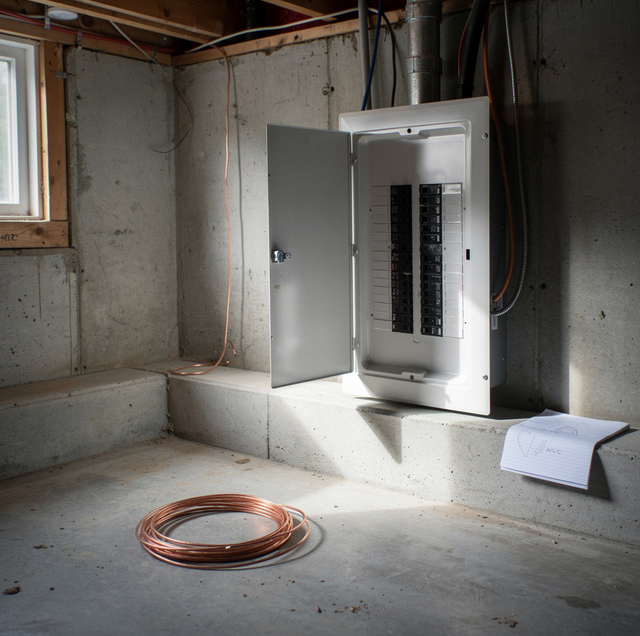
A quote for a whole-home standby unit often starts with a number unrelated to sizing: the amperage rating stamped on the main panel. A 200-amp panel gets a larger generator recommendation; a 100-amp panel gets a smaller one, and that's the reasoning. It feels logical. It is the assumption that a load calculation exists to replace.
A generator is sized to the electrical load it has to carry, not to the panel's service rating. Two numbers decide that load: the running wattage of everything you want the unit to power at the same time, and the starting wattage of the single largest motor among those loads in the instant it switches on. The panel's amperage rating describes the maximum current the house's wiring can carry; almost no household loads draw anywhere near that ceiling at once, generator or not. Get those two numbers right, account for how the loads are sequenced, and confirm what the fuel supply can actually deliver, and the rest of the sizing decision follows from there.
Running Watts Set the Floor, Starting Watts Set the Ceiling
Every appliance and circuit has a running wattage, the power it draws once it's operating steadily. Add up the running wattage of everything you intend the generator to power, and that total sets the floor a generator must clear just to keep the essentials going at the same time.
Starting wattage is a different number and applies only to equipment built around an electric motor: an air conditioner compressor, a well pump, a septic pump, a furnace blower, a garage door opener. A motor at rest produces no back-EMF, the opposing voltage a spinning rotor generates, so for the fraction of a second before the rotor comes up to speed, the winding sees nearly the full supply voltage across its impedance and current runs far above the running figure. That surge sits on the equipment's nameplate as locked-rotor amps (LRA), the figure a load calculation uses for a motor's starting demand, right next to the running-load amps (RLA) most homeowners notice.
Generator exhaust contains carbon monoxide, which is odorless and colorless, and an improperly isolated generator can push power back onto utility lines and endanger line crews. Placement and isolation are decisions for the installing electrician.
The generator only has to hold that peak for the second or two it takes the motor to spin up; once it reaches speed, the draw settles back to the running figure. But the unit has to be capable of producing that peak at all, and the single largest starting surge among everything you plan to run, layered on top of the running total from everything else, is what actually sets the generator's rated capacity.
The Load Inventory Ranks Circuits by Draw and Surge
A load inventory starts with every circuit the panel actually feeds. Two categories tend to get misjudged: the small loads with outsized starting surges, and the large loads that draw plenty of running wattage but barely surge at all.
A well pump, a septic system's effluent pump, and a furnace blower fall in the first category. Each one draws modest running wattage, often under a kilowatt, which makes it easy to underweight. But every one of them is a motor, and every one produces the same brief starting spike described above. A homeowner planning around running wattage alone can miss that a well pump's momentary surge, layered onto everything else already running, is what actually strains the generator. A refrigerator belongs in the same category for a slightly different reason: its running wattage is small, but food loss during an extended outage puts it near the top of most households' list regardless, and its compressor still produces a real, if modest, starting spike.
A central air conditioner and an electric range sit at the other end. Both draw large running wattage, and both show up on every homeowner's first guess at what needs power. But they behave differently at startup: the air conditioner's compressor is a motor and produces the single largest starting surge in most homes, while an electric range's heating elements are resistive and draw their full wattage the instant they're switched on, with no separate starting spike.
| Load | Running draw | Starting behavior |
|---|---|---|
| Well or septic pump | Modest, often under a kilowatt | Motor-driven; brief high surge |
| Furnace blower | Modest | Motor-driven; moderate surge |
| Refrigerator | Small | Motor-driven; small surge |
| Central air conditioner | Large | Motor-driven; largest surge in most homes |
| Electric range | Large | Resistive heating; no separate surge |
Load Management Is the Biggest Lever on the Final Number
Add every running watt in the house to the single largest starting surge, and the total describes a worst case: every motor that could conceivably overlap, overlapping. Few households actually need a generator sized for that worst case, because a load management module changes what "worst case" means.
The module sits between the generator and the panel and watches current in real time. When a lower-priority circuit is already drawing power and a higher-priority motor needs to start, the module holds the lower-priority load off until the surge has passed, then restores it on a timer that commonly runs a minute or more rather than seconds. The module controls only the circuits it is wired to manage, which is usually the air conditioner and one or two other large appliances. A well pump and a furnace blower sitting on unmanaged circuits can still start within the same second, so the calculation has to assume any unmanaged motors overlap.
That sequencing is what lets a mid-size unit carry a house that would otherwise need a much larger one. Two homes with identical total running watts and an identical list of motors can end up with different generator sizes, purely because one plans to stagger starts and the other lets everything compete for power at once. Of every variable in the calculation, this one moves the final kW number more than any single appliance swap could.
The Fuel Supply Sets Its Own Ceiling
A generator sized correctly on paper still depends on getting enough fuel fast enough to hit that output, and that's a separate calculation from the electrical one.
A natural-gas unit draws from the same meter and service line already feeding the furnace, the water heater, and possibly a range. That meter has a maximum delivery rate, and running a generator alongside everything else already on the line can exceed it. The gas utility has the final say on whether the existing meter can support the additional draw or needs to be upsized first.
A propane unit answers to its tank and its regulator. A larger generator burns propane faster, and if the regulator or the line running to it wasn't sized for that draw, the unit can starve under load with a full tank sitting a few feet away. Tank size governs both runtime and peak output. Propane has to vaporize inside the tank before it reaches the generator, and that vaporization rate scales with the tank's wetted surface area and falls as temperature drops, so a small tank in cold weather cannot boil off gas fast enough to hold rated load, however well the rest of the system is sized. Regulator and line sizing govern delivery from the tank onward.
A generator that clears the wattage math but outruns what its fuel source can deliver won't perform to its rated output. Fuel delivery gets confirmed as part of the same visit that produces the load calculation. Whether the installation requires a permit and what an inspector checks are questions for the local electrical authority and vary by jurisdiction; the electrician doing the sizing typically handles that step as part of the job.
What Oversizing and Undersizing Each Cost You
Oversizing feels like the safe direction, and it carries its own costs. A residential standby unit runs a spark-ignition engine on natural gas or propane, and that engine reaches full operating temperature and burns its fuel cleanly only under a meaningful percentage of its rated load. An engine sized well beyond what the house ever actually asks it to carry spends its run time lightly loaded, where carbon builds up on the plugs and valves and unburned fuel works past the rings into the crankcase and thins the oil. A larger unit also raises the peak fuel-delivery rate the meter, tank, or regulator must support, which means paying for output capacity that sits unused for the entire life of the unit.
Undersizing shows up as a failure at the exact moment the generator is needed most. A unit asked to produce more starting surge than it's rated for sags in voltage and frequency, which can stall a motor mid-start or shut the generator down on its own overload protection. A calculation that only accounts for running watts, and skips the largest starting surge, tends to look fine on paper right up until the day two big loads happen to start close together.
Both failure modes trace back to the same root: a size chosen from a rule of thumb, a panel amp rating, or a square-footage chart. An actual accounting of what the house's motors and continuous loads demand is the only input that avoids both.
Frequently Asked Questions
Square footage doesn't factor into the sizing calculation. A large home with a heat pump and no other big motors can call for less generator than a smaller home running a well pump, a septic system, and a large central air unit, because the number comes from motors and continuous draw.
Adding a major motor load later, a second air conditioner or a hot tub pump, can push the house's totals past what the existing unit and its load management module were programmed to handle. The module usually needs reprogramming to add the new load into the sequencing plan, and in some cases the generator itself has to move up to a larger unit.
General lighting and small-appliance receptacle circuits account for a modest share of a home's total running wattage, so they almost never drive the sizing decision on their own. They still get counted in the running total; they just rarely decide which generator model clears it.
Their locked-rotor currents stack for that first fraction of a second, and the combined spike can pull the generator's output past what its own overload protection allows, tripping the unit offline. That's a more severe failure than a simple voltage sag, and it's the very scenario load management exists to prevent.
Yes. Pool and spa equipment commonly runs on its own GFCI-protected circuit for shock protection near water, and that pump is a motor with a starting surge like any other, so a load calculation counts it as a separate line item with its own surge, apart from general outdoor circuits.
An engine's rated output assumes a specific temperature and air density, and both heat and altitude reduce how much power it can actually produce. A unit sized to the calculated wattage with no cushion can fall short on the hottest days of the year, which is why installers build a margin into the final number.
Ask for a load calculation before you buy a standby generator — so the size you pay for matches what your house will actually ask it to carry. Wired Up Electrical serves Lynchburg, Forest, and Bedford. Call (434) 254-1264.
