
How Many Circuits Does a Kitchen Need? 7 to Plan For
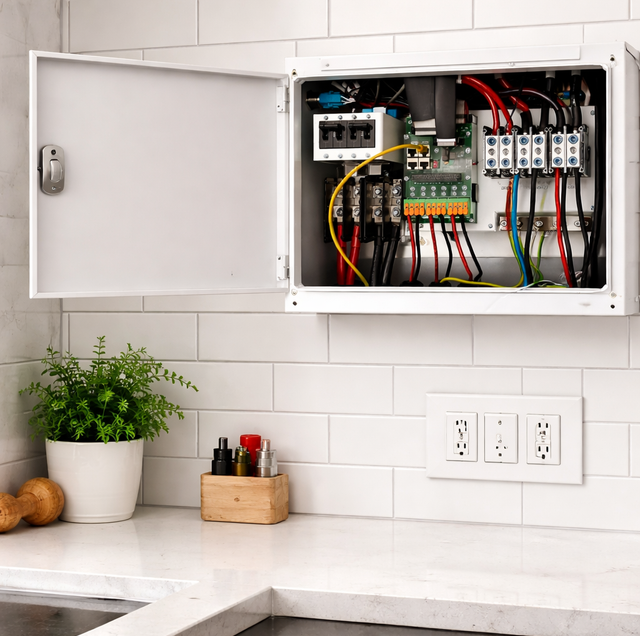
Quick Answer: A modern kitchen usually needs several dedicated circuits, not one. Plan on at least two 20-amp countertop circuits plus separate circuits for the range, dishwasher, disposal, microwave, and refrigerator. Countertop outlets need GFCI protection, and most kitchen circuits now need AFCI protection too.
The kitchen you cook in today asks far more of your wiring than the kitchen your house was built with. A 1960s kitchen ran a fridge, a few lights, and maybe a toaster on a single circuit and called it done. Now the same countertop holds an air fryer, an espresso machine, a stand mixer, a microwave, and a phone charger, and every one of them wants power at the same busy moment. When all of that lands on one circuit, the wiring behind the wall has no way to carry the load, and the breaker does exactly what it was designed to do: it trips.
So the real question is not whether your kitchen has enough outlets. It is whether those outlets ride on enough separate circuits to run everything at once without tripping, overheating, or quietly stressing the wire year-round.
Why One Circuit Is Never Enough
A circuit is a loop of wire rated to carry a set amount of current, protected by a breaker in your panel. A common kitchen branch circuit is 20 amps. That number is a ceiling, not a target. Pull steady current close to that ceiling and the wire, the outlets, and the breaker all run warm.
Here is what too much on one circuit actually feels like day to day.
The breaker trips: Start the microwave while the toaster is already going, and the combined draw pushes past the breaker's rating. The breaker cuts power to protect the wire. Annoying, yes, but the trip is the safety system working, not failing.
Cords and outlets run warm: A circuit loaded near its limit for long stretches heats the connections along the way. A faceplate that feels warm to the touch, or a plug that is hot when you unplug it, is a signal the circuit is carrying more than it should.
Slow, hidden wear: Even when nothing trips, running a circuit hard for years fatigues connections and can loosen terminals over time. That is the failure mode you never see coming, and it is the reason dedicated circuits matter as much for safety as for convenience.
The fix is to spread the load. Instead of one loop carrying the whole kitchen, you give the heavy and the constant users their own loops. A dedicated circuit serves one appliance or one defined job and nothing else, so that appliance never has to share its ceiling with the coffee maker.
Think of a single kitchen circuit as a two-lane bridge in a town that grew into a city: it was fine for the traffic it was built for, but bumper-to-bumper appliances now need several bridges, not one wider lane on the old one.
The Circuits A Modern Kitchen Needs
Current electrical code, as adopted and enforced locally, sets minimums for kitchen wiring, and those minimums have climbed over the decades. Rules vary by jurisdiction and by the age of your home, so a licensed electrician verifies the exact requirements against your local code before any work. The list below is the shape of a typical modern kitchen, not a code citation.
Two or More Small-Appliance Countertop Circuits: The countertop is where the plug-in appliances cluster, so it gets the most attention. A modern kitchen carries at least two 20-amp small-appliance circuits dedicated to the countertop and dining-area receptacles. Two circuits mean the toaster and the kettle can pull from different loops, so running both at once no longer trips a breaker. In a larger kitchen, or one with a long run of counter, an electrician may add a third or fourth so no single stretch of counter is doing all the work.
A Dedicated Circuit For The Range Or Oven: An electric range or wall oven is the heaviest single load in the kitchen. It runs on its own 240-volt circuit, sized to the appliance and fed by a breaker rated well above the 20-amp countertop circuits. Nothing else shares it. If your range is gas, the burners need no electricity, but the igniter, clock, and controls still plug in, so a standard circuit still serves it.
Dishwasher and Disposal: The dishwasher and the garbage disposal each draw a meaningful, sometimes simultaneous load, and both sit under the sink where water is present. They are commonly given their own dedicated circuits, or wired as a pair to a shared circuit only when the combined draw and local code allow it. Separating them keeps a mid-cycle dishwasher from tripping the moment someone flips the disposal.
A Dedicated Microwave Circuit: A built-in or over-the-range microwave pulls a steady, heavy load whenever it runs, enough that sharing a circuit with the countertop outlets is a recipe for nuisance trips. Most modern installs give the microwave its own dedicated circuit so it never competes with the toaster or the mixer.
A Refrigerator Circuit: The refrigerator runs day and night, and a tripped breaker it shares with a countertop appliance can quietly spoil a fridge full of food before anyone notices. Putting the refrigerator on its own circuit keeps it running no matter what else trips, and it steadies the voltage the compressor sees.
Protection: GFCI And AFCI
Getting the number of circuits right is only half the job. The circuits also have to be protected, and kitchens carry two kinds of protection for two different hazards.
GFCI (ground-fault circuit interrupter) protection guards against shock. It watches the current going out and coming back, and if even a small amount leaks, say through a person or through water, it cuts power in a fraction of a second. Because kitchens combine water and metal appliances, countertop receptacles serving the counter surface require GFCI protection. That protection can live in a GFCI outlet or in a GFCI breaker at the panel.
AFCI (arc-fault circuit interrupter) protection guards against fire. It listens for the electrical signature of a dangerous arc, the kind a damaged cord or a loose connection can throw, and shuts the circuit down before that arc can ignite anything. Current code extends AFCI protection to most kitchen circuits. Some outlets end up needing both kinds of protection at once, which is handled with a dual-function device or breaker. Which circuits need what, and where the protecting device belongs, is exactly the kind of detail an electrician confirms against your local code.
Why A Remodel Or New Island Usually Means New Circuits
If you are opening up the kitchen, moving the range, or adding an island, plan on new circuits rather than assuming the old wiring will stretch to cover it.
An island is the clearest case. Add a permanent island or peninsula with a countertop, and the outlets it needs almost always call for their own dedicated small-appliance circuit run out to the island under the floor, because the existing countertop circuits are already spoken for. A remodel that adds a second wall oven, a warming drawer, a built-in coffee system, or a beverage fridge adds loads the original panel layout never planned for, and each heavy addition tends to want its own circuit.
This is also the moment to look at the panel itself. Every new circuit needs an open breaker slot and enough overall service capacity to carry it. An older home with a small panel, or one already full of breakers, may need a subpanel or a service upgrade before it can support a modern kitchen. That assessment is a core part of planning any kitchen electrical project, and it is not something to guess at from the number of empty slots alone.
This Is Licensed-Electrician Work
Adding circuits, wiring a 240-volt range, and touching a panel all involve lethal voltage and, in nearly every case, a permit and an inspection. Do not add DIY circuits to a kitchen, and do not solve a tripping breaker by swapping in a bigger one, since a breaker sized above the wire's rating removes the protection and turns a nuisance trip into a fire risk. Treat a repeated trip, a warm faceplate, or any scorch mark or burning smell near a receptacle as a reason to call a professional: A breaker that trips repeatedly, an outlet or faceplate that is warm to the touch, any scorch mark or burning smell near a receptacle, or a kitchen where you are constantly juggling which two appliances can run at once. Each of those points to a kitchen asking for more circuits than it has.
Frequently Asked Questions
There is no fixed outlet count on a residential branch circuit, because the load matters more than the number of receptacles. What governs a kitchen countertop circuit is spacing: code requires a receptacle within reach along the counter so no point is far from an outlet, which is why counters end up with outlets every few feet. You can have several receptacles on one circuit as long as the appliances plugged in do not exceed its rating at the same time.
The gas burners themselves need no electricity, but a modern gas range still plugs into a standard 120-volt outlet to run its igniter, control board, clock, and oven light. That outlet does not need its own dedicated circuit the way an electric range does, though the convection fan and self-cleaning cycle on higher-end gas models can draw enough that an electrician may still recommend one.
An electric range typically runs on a 240-volt circuit protected by a 40- or 50-amp breaker, which calls for a heavier gauge of copper than the 12-gauge wire used on a 20-amp countertop circuit. The exact breaker and wire size match that specific range's nameplate rating, so two homes can correctly use different sizes for different ovens.
Sometimes, where local code permits and the combined load stays within the circuit's rating, a dishwasher and disposal are wired to one shared 20-amp circuit, often through a switch. Many electricians still prefer separate circuits so a heavy disposal jam cannot knock out a dishwasher mid-cycle, and so each can be serviced without killing power to the other.
Not always, but it depends on two things: open breaker slots and total service capacity. If your panel has room and your service amperage can carry the new load, an electrician adds circuits directly. If the panel is full or your home has a small service, a subpanel or a service upgrade from 100 to 200 amps may come first so the added kitchen load does not exceed what the service can safely deliver.
Repeated GFCI trips usually mean the device is detecting real current leakage, not a false alarm. Common culprits are an appliance with a failing motor or heating element, moisture that has worked into an outlet box near the sink, or a long circuit shared by several outlets where one downstream fault trips the whole run. An older, worn GFCI can also trip on its own, so testing which appliance or receptacle triggers it is the first step an electrician takes.
Book a kitchen circuit assessment — get the dedicated circuits and panel capacity your appliances actually need. Wired Up Electrical serves Lynchburg, Forest, and Bedford. Call (434) 254-1264.
