
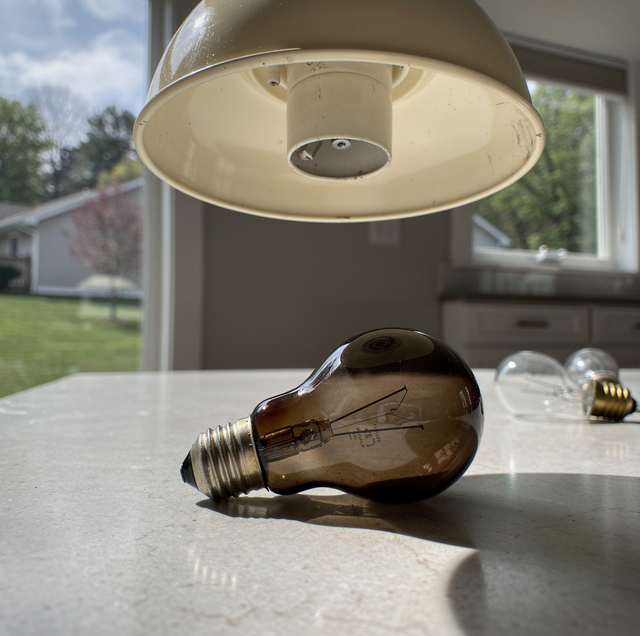
A bulb that fails early in one fixture, while the same bulb lasts for years in the next room, has already told you where to look. Unless the bulbs all came from one bad batch, the fault sits in the bulb chosen for that fixture, the fixture, its socket, the control on its wall, or the circuit feeding it, and each of those leaves a different trace on the bulbs that come out of it. Each thing you can see from the floor pairs with a likely cause:
| What you see | Likely cause |
|---|---|
| Bulbs die early inside a closed globe or dome, with darkened glass or a browned base | An incandescent bulb above the fixture's wattage limit, or heat trapped around a bulb not built for it |
| LED bulbs fail in a sealed fixture while the same model keeps working in an open lamp | An LED not rated for enclosed fixtures, with its driver overheating |
| The light cuts out, and returns, and old bulbs show dark pits on the button at the tip | A loose socket contact or a flattened center tab |
| Filament bulbs break in a ceiling fan light kit or beside a door that slams | Vibration breaking a hot filament |
| LEDs fail early or glow faintly while switched off on a dimmer or smart switch | A dimmer or switch not matched to the bulb |
| Bulbs burn out in several fixtures on different circuits | High voltage at the service, or a loose neutral |
| Brown scorch marks, a melted socket, or brittle wire insulation | Heat damage that calls for replacing the fixture |
Heat Inside Enclosed Fixtures
A label near the socket gives the fixture's maximum bulb wattage. That number works as a heat limit for the socket, the fixture wiring, and the glass around the bulb. An incandescent bulb converts most of its power into heat, so a 100-watt bulb in a fixture marked for 60 pushes extra heat into a space sized for less.
In an open fixture, that heat rises off the bulb and escapes. In a closed dome or a sealed globe, it stays put, the filament thins, the cement holding the glass to the base softens, and the bulb quits early. A darkened or discolored bulb is one sign that heat did the work.
LEDs change the problem without removing it. An LED draws a fraction of the wattage for the same light, so the limit that matters becomes the driver, the small power supply packed into the bulb's base, whose components are sensitive to heat. Sealed inside a glass dome, that heat has nowhere to go, and the driver can fail while the light-emitting chips are still sound. LED packaging states whether a bulb is rated for enclosed fixtures, and a bulb without that marking inside a sealed fixture is a likely reason an LED died where its twin in a table lamp keeps going.
Matching the bulb to the fixture, an incandescent at or under the labeled wattage or an LED marked for enclosed use, settles the problem for as long as the fixture itself is undamaged. When heat has already browned the socket or stiffened the wires, the decision moves to replacement.
The Socket and Its Center Contact
A screw-in socket makes contact at two points: the threaded metal shell that the bulb's base turns into, and a small brass tab at the bottom of the socket that presses against the button on the bulb's tip. That tab is a spring, and its tension holds the two metal pieces together.
Years of bulb changes and bulbs screwed in hard push the tab down until it lies flat and stops pushing back. Heat from the bulb can soften the brass and take away its spring as well. Once contact pressure drops, current crosses a smaller patch of metal, resistance at that point climbs, and the joint heats. A weak contact can also arc across a gap too small to see, pitting the button on the bulb and the face of the tab. That heat lands at the bulb's base, where an LED keeps its driver and where an incandescent's lead wires are soldered, so bulbs in this socket state fail early.
Damp locations add corrosion to the list. A porch light or a bathroom fixture whose socket shell has corroded makes the same poor contact by a different route, and an outdoor fixture not rated for damp or wet locations lets moisture reach the socket in the first place. The same heating can start one step back, at a loosened screw terminal on the socket or a loose wire connector in the fixture box, cooking the socket from behind and leaving the same trail of failed bulbs.
Any look at the socket starts with the breaker off, not only the wall switch, because a switch wired into the neutral leaves the socket energized with the switch down. With the breaker off and the bulb out, a tab lying flat against the socket floor, dark pitting on its face, or a shell stained brown can all be seen without touching anything. Leave the tab itself alone. Brass that has lost its spring to heat may not hold a new bend, and a socket in that condition gets replaced.
Keep the last two or three failed bulbs from the fixture, along with the packaging from the bulbs in it now. The old bulbs show the damage pattern and the packaging shows the enclosed and dimmable markings.
Vibration and the Filament
An incandescent filament is a coil of tungsten wire thinner than a hair, and while it is lit it runs white-hot and soft. A jolt that a cold filament shrugs off can snap or sag a lit one. A ceiling fan light kit shakes whenever the blades turn. A fixture beside a door that slams, or under a room with heavy foot traffic, takes a shock with each impact.
Standard LEDs have no tungsten filament to snap, so switching a shaking fixture to LED removes the filament from the equation, though the solder joints inside an LED can still suffer in a fixture that moves hard.
Dimmers, Switches and LED Compatibility
The control on the wall shapes what reaches the bulb. An LED that is not marked dimmable was built for a steady supply, and on a dimmer its driver receives a chopped supply it was never designed for, with early failure as one outcome. Dimmable LEDs can still fail early on a dimmer never meant for them, and the answer there is matching the dimmer and the bulb as a pair.
Smart switches, lighted toggle switches, and some motion sensors add a different stress. To keep their own electronics running, some of them pass a trickle of current through the light while it is switched off. An incandescent filament ignores that trickle. An LED driver can charge up and glow faintly, or try to start again and again in the dark, working all night while the room looks idle. On a smart switch, one fix is a model that draws its standby power from a neutral wire in the switch box; if the box has no neutral, adding one requires wiring work.
Dimming runs the other way for a filament. An incandescent bulb held below full brightness runs cooler and lasts longer, so a working dimmer is unlikely to be the culprit when a filament bulb keeps dying.
Voltage Problems That Reach More Than One Fixture
Household lighting circuits run at a nominal 120 volts, and delivered voltage is held within roughly 5 percent either side of that. An incandescent bulb is sensitive to where in that band it sits: running about 5 percent above its rating cuts its life roughly in half, because the filament runs hotter and loses tungsten at a higher rate. LED drivers accept a wider input range, though sustained high voltage and repeated surges can wear them down.
The first clue that points to voltage rather than a fixture is spread. One fixture eating bulbs points first at that fixture. Bulbs failing in several rooms, on different circuits, point upstream of any single socket to the panel, the service, or the supply.
A home's 120-volt circuits are split between two halves of the service, and both halves share a single neutral conductor back to the utility. When that neutral connection loosens, the halves no longer share evenly: one side can climb above 120 volts while the other sags, and bulbs on the high side burn out in a cluster. Electronics on the high side take the same overvoltage.
An electrician's readings at the panel under load, on both halves of the service, separate a supply problem on the utility's side from a failing neutral inside the house.
When the Fixture Itself Gets Replaced
Some fixtures are past a bulb change. Heat that has run for years in an over-lamped or sealed fixture leaves marks: a socket browned or cracked, a plastic shell gone brittle, wire insulation inside the fixture that flakes when the canopy comes down. A fixture in that state keeps killing bulbs because its contacts and insulation have degraded, and it carries a fire risk of its own.
A browned or melted socket or fixture wiring whose insulation crumbles indicates the fixture has been overheating or arcing; keep the breaker off and the fixture untouched, and have a licensed electrician replace it and check the box wiring behind it.
Replacement also makes sense when the socket is riveted or molded into the fixture pan, which on some fixtures leaves no separate socket to swap, and when the fixture is the wrong type for its spot, such as an indoor-rated fixture over a shower or on an open porch. Replacing with sockets rated for its bulbs and with a damp or wet rating where needed addresses why the old one kept failing bulbs.
A fixture with a clean socket, supple wiring, and a correct rating for its location is worth keeping, and a matched bulb or a new socket puts it back in service.
Frequently Asked Questions
They lengthen the life of incandescent bulbs without fixing the cause. A bulb designed for 130 volts runs cooler at household voltage, producing somewhat less light in exchange for longer life. In a high-voltage-fed fixture, it hides a fault that also affects every appliance on that side of the service. They suit a hard-to-reach fixture once the voltage has been measured as normal.
A cold tungsten filament has a small fraction of its hot resistance, so for a split second at switch-on the bulb draws a surge on the order of ten times its running current. A filament already thinned by heat or age breaks at its weakest point under that surge.
Yes. Skin oil left on the quartz glass of a halogen capsule heats unevenly once the lamp is lit, and the spot can weaken or crack the glass. Handle a halogen capsule with a clean cloth or gloves, and if bare fingers touched it, wipe the glass with rubbing alcohol and let it dry before inserting the bulb, with the breaker off.
It can. A recessed can housing carries a thermal protector that cuts power when the housing overheats and restores it once it cools, so the light goes dark and returns on its own. Insulation packed against a housing not rated for insulation contact, or a bulb above the housing's wattage, can trip it. Housings marked IC are built for direct contact with insulation.
It means the fixture produces enough heat in its outlet box that the house wiring connected to it requires insulation rated for 90 degrees Celsius. Older cable with insulation rated for 60 degrees can bake and crack at the box under a fixture labeled for that rating. The fix is either to rework that connection with heat-rated conductors or to choose a fixture without that requirement.
Yes. Rough-service bulbs carry extra support wires that hold the filament at more points along its length, so a jolt that would snap a standard filament leaves it intact. They trade some light output for that toughness, and they are sold for work lights and other fixtures that take regular knocks.
Bring in an electrician for a lighting repair on the fixture that keeps burning out bulbs — check the socket contact, heat rating, and circuit voltage, and replace a heat-damaged fixture. Wired Up Electrical serves Lynchburg, Forest, and Bedford. Call (434) 254-1264.