
5 Things to Check Yourself Before You Call an Electrician
Either the kitchen lights are flickering while you stand there holding the phone, or they stopped twenty minutes ago, and the room looks entirely ordinary. In the first case, you can still switch the microwave on and watch the ceiling fixture do it again. In the second, the fault has taken its evidence with it, and an electrician arriving tomorrow afternoon finds a circuit that behaves perfectly.
The few minutes before you dial are worth spending. What a homeowner can establish with the panel cover on and a phone in hand changes where an electrician starts and whether the visit turns into a search. None of it needs a tool, and the part that matters cannot be gathered by anyone who was not in the room.
An Electrician Starts Where the Description Points
A call that says an outlet is dead and a call that says three outlets along one wall went dead while the vacuum was running, with every breaker still on, send an electrician to two different places. The first describes a symptom. The second names the load and the panel that never reacted, and that rules out a tripped breaker before anyone gets in the van.
The caller is not being asked for a diagnosis. An electrician wants the conditions under which the fault occurred, and they stop existing the moment the fault does. Voltage and continuity stay measurable tomorrow. Whether the freezer had just kicked on does not.
The description also changes what gets scheduled. A dead receptacle with a known cause is a device replacement. A symptom nobody can reproduce becomes a search through terminations that needs time set aside for testing. Saying which of the two you have, in the words you would use to a neighbor, beats guessing at a cause.
None of this asks you to work out what is wrong. A cause offered on the phone sends the visit down one branch and leaves the others unchecked, so describe what happened and in what order.
What Can You Establish With the Covers On?
Start by fixing the size of the problem. Walk the rooms with a lamp, and check whether anyone else on the street is lit. A dark house, one dead room, one dead receptacle and one dead appliance are four different faults, and they fall in that order along the path from the utility's wire to the thing you plugged in.
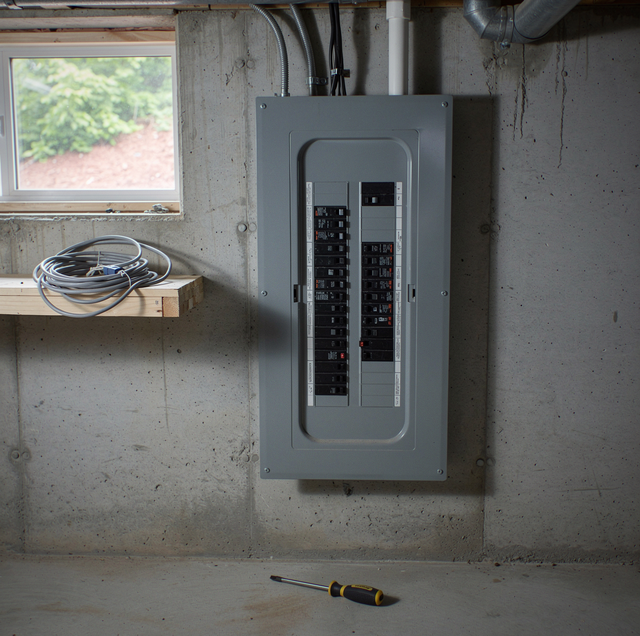
The panel face shows the next thing without the cover coming off. A handle out of line with its neighbors, or a reset button standing proud on a bathroom or garage receptacle, is visible from arm's length. Cycling a tripped handle fully off and back on, or pressing a reset once, ends a homeowner's involvement with the panel. If it holds, you have something to report. If it drops again straight away, you have something better, and it belongs on the phone.
Manufacturer guidance for a panel's load center directs you to confirm nobody is working on the electrical system before you reset a tripped handle, and not to reset one repeatedly without resolving what caused it. Past that cover, your checking stops.
Everything past that point is an electrician's job, and the reason is not fussiness. Reading a live conductor means the cover is off and the busbar is exposed the moment your hands are inside the enclosure, which is why that work belongs to someone with insulated tools and the training to stand in front of it. The checks worth making before you call need none of it.
The Load That Was Running at the Moment It Failed
Connections that have loosened over the years do not fail on a schedule. They fail when enough current runs through them. Heat at a poor joint follows the square of the current through it, so a joint that runs barely warm at two amps gives off roughly thirty-six times the heat at twelve, which separates a lamp from a space heater on the same receptacle. An electrician who knows what was drawing current at that second knows roughly what the joint in your wall was being asked to pass.
Nobody expects a load calculation from you. The ordinary account does the work: the dryer had been running an hour, and someone had just plugged the vacuum into the hall outlet. Timing matters as much as the names, because two appliances that overlap for four seconds put a very different peak through a joint than two that never coincide. A motor's starting draw is short and steep, and lands on whatever the wiring already carried.
When Is It Worth Making the Problem Happen Again?
A symptom you can bring back on command is worth more than one you can only describe, and some come back safely. If the hall light dims whenever the fridge compressor starts, switching the fridge on again with someone watching the light settles whether the two share a run. If the bathroom receptacle dies whenever the hair dryer reaches its high setting, running it once more confirms the load level at which it occurs, a number an electrician can use.
Write down whether the light dimmed and recovered or went dark, and what you switched on in the same second. Manufacturer guidance separates a startup flicker from persistent dimming.
The other half of the question is which symptoms you leave alone. Anything that produced heat or a smell inside a box has already shown what it can do, and repeating it asks the fault to run again unseen. Those get described, not reproduced, and the circuit stays off at the panel until someone can open the box safely. Whether a symptom can wait for business hours is a different question from what you can establish about it, and it turns on the symptom itself.
The value of a repeatable symptom is that it survives the wait. A fault you can trigger while the electrician is standing in the room turns a search into a measurement and removes the visit's dependence on your memory. Say so when you book, because a symptom you can produce on demand changes when the appointment is worth having.
The Recent Change Only Your Household Can Report
Work done in a house leaves consequences that surface later, and the household is the only party that can date them. A ceiling fan went up last spring, and the switch has hummed since. A freezer moved into the garage and started sharing a receptacle with the second fridge. Neither is visible from the outlet that stopped working, and neither is in the panel directory.
The window that matters is wider than the last few days. A cable pinched by a screw during a bathroom refit can carry current for months before the damaged strands finally part, so the question worth answering is what has been done to your house since the circuit last worked properly, including work nobody thought was electrical. A mounted television or a shelf screwed to a wall that a cable runs behind puts a fastener into a cavity, and the person holding the drill is the only one who knows where it went.
The First Move With a Suspect Appliance
The first thing an electrician does with an appliance under suspicion is carry it somewhere else. A toaster that trips the kitchen breaker goes on the end of an extension lead into a bedroom receptacle on a different circuit, gets switched on, and either trips that breaker too or runs without complaint. One outcome puts the fault inside the appliance, where a cord or an internal winding has failed to earth. The other clears the appliance and points at the circuit it was on, so the boxes on that run become the first thing a technician opens. The move takes a minute, requires no meter, and you can make it before the call as easily as an electrician can after.
The move is only valid if the second receptacle is actually on another circuit. Two outlets on opposite sides of a wall can be on the same run, and moving the appliance between them doesn't change anything underneath it. A receptacle at the far end of your house keeps the test honest.
The move does not reach a fault in fixed wiring. A lighting circuit, or anything that failed with nothing plugged in, has no appliance to move, and the reasoning does not carry across. It also stops at a device that showed heat or a smell, which goes to an electrician untouched.
A vacuum that trips a breaker in every room of the house is a vacuum. That result changes which trade you are calling, and nothing about it needs an electrician to establish.
Frequently Asked Questions
Voltage at your receptacle with nothing plugged in tells an electrician little, because a loose or corroded joint develops voltage across itself only in proportion to the current through it. So they apply a deliberate load of their own and watch the voltage at the outlet while it runs. A joint at a healthy 120 volts unloaded sags measurably under 12 amps, and the extent of the sag locates the joint for you.
Because it carries information that you cannot say over the phone. With the cover still on, a photo shows the number stamped on the main breaker's handle, which is the rating of your main disconnect, and it shows how many spaces are filled. It also shows your directory card, and a card that is blank or contradicts itself is worth reporting. Send the photo ahead of your appointment rather than describing it.
Always, and with the result attached. If you reset a breaker and it held for two days before dropping again, that is a different fault from one that never held, and you are the only person who can supply that interval. The same goes for a GFCI you pressed or a bulb you swapped. Otherwise the electrician repeats your work while you watch, and the first stretch of the visit buys nothing.
It can, in one way. A failed part is evidence, and replacing it before anyone sees it throws that evidence out. A plug with one prong darker than the other tells an electrician which side of the connection ran hot. Keep the old part instead of binning it, and leave the device in your wall once it has failed. If you already replaced it, keep what came out and say so when you book.
Yes, but from the ground and no nearer. The service conductors reach the house at a weatherhead, run down to the meter, and enter the panel from there; that whole path is visible from your yard. A cable pulled away from the mast, or a limb resting on the drop, is describable without leaving the lawn. Where a utility's responsibility ends varies, so an electrician can say which call comes first.
Whoever was in the room, even if that is not you. A description thins every time it is passed on, and the details that go first are the ones an electrician wants: which direction a smell came from, whether one room went dark or several. Ask that person and write down their words rather than summarizing them in your own words. If you are calling and you were not there, offer to put them on the phone with you.
A fault that only shows itself under load is worth a visit while it is still showing — what a meter registers with that load running on your own circuits cannot be reconstructed from an account of it afterward. Wired Up Electrical serves Lynchburg, Forest, and Bedford. Call (434) 254-1264.
