
Why Big Appliances Need Their Own Dedicated Circuit
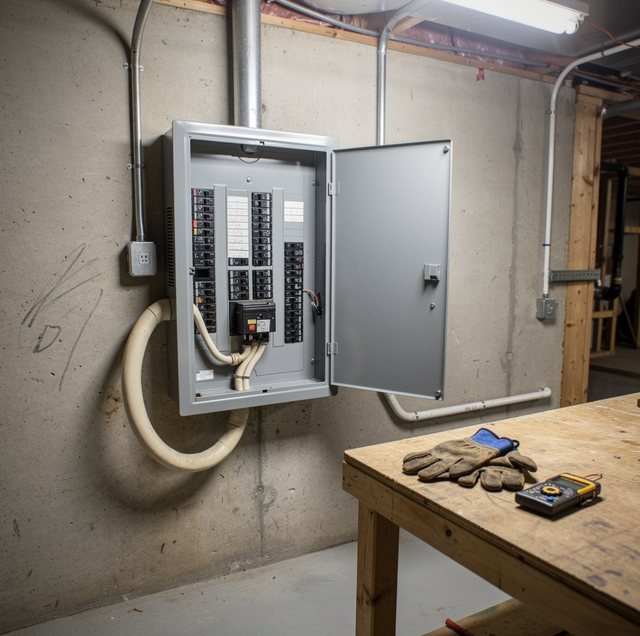
If any of these sound familiar, the underlying issue usually comes down to whether a large appliance is on a circuit built specifically for its load or is sharing capacity with something else.
A Dedicated Circuit Exists Because Big Appliances Draw Current Differently Than Lights or Outlets
A ceiling light and a phone charger draw a small, steady trickle of current. A clothes dryer, electric range, central air compressor, or water heater draws far more, often continuously, for the entire time it's running. A dedicated circuit means that appliance has its own wire run, its own breaker, sized specifically for its rated draw, with nothing else sharing that capacity.
Without a dedicated circuit, a large appliance is essentially competing with whatever else is plugged into the same circuit at the same moment. That's why a breaker that never trips when the dryer runs alone suddenly trips the moment someone also runs a hair dryer or space heater on an outlet nearby: the combined draw exceeds what the shared circuit and breaker were rated to carry.
| What you're noticing | Likely cause | What it usually means |
|---|---|---|
| Breaker trips when the microwave and toaster run at once | Two loads sharing one circuit's amperage | The circuit isn't dedicated and can't carry both loads simultaneously |
| Lights dim briefly when the AC compressor or well pump kicks on | A large motor start-up draw sharing wiring with lighting | The startup surge is pulling voltage away from other devices on that same circuit |
| Dryer or range outlet gets warm during a long cycle | Wire gauge undersized for the appliance's continuous draw | The circuit is carrying more sustained current than it was built for |
| Breaker trips only when a specific appliance runs, never otherwise | The appliance is likely already on its own circuit, but sized wrong | The dedicated circuit exists, but the breaker or wire gauge doesn't match the appliance's actual rating |
Motor-Driven Appliances Draw a Sharp Spike the Moment They Start
Appliances with a compressor or motor, an air conditioner, refrigerator, well pump, or garbage disposal, don't draw a steady amount of current the whole time they run. They pull a sharp spike, sometimes several times their running current, in the first fraction of a second as the motor starts turning, then settle down to a lower steady draw once it's up to speed.
That startup spike is why lights on a shared circuit sometimes dim briefly when a compressor kicks on: the sudden draw pulls voltage away from everything else on that circuit for an instant. A dedicated circuit sized for that appliance's startup current, not just its running current, avoids putting that spike in competition with anything else in the house.
Wire Gauge Has to Match the Appliance's Continuous Draw, Not Just Its Peak
An electric dryer typically runs on a 240-volt, 30-amp circuit wired with 10-gauge copper, while a larger electric range often requires a 50-amp circuit and 6-gauge wire, both heavier than the 14- or 12-gauge wire typical of a lighting or general outlet circuit. That heavier gauge isn't overkill; it's what's needed to carry that level of continuous current without the wire heating up over the length of a full drying or cooking cycle.
A circuit sized correctly for a lighter load but pressed into service for a major appliance runs hotter than it should during every cycle, degrading insulation and connections over repeated use, even if a breaker never trips to show something's wrong.
Some Appliances Need Their Own Circuit for Safety Reasons, Not Just Capacity
A few appliance categories carry dedicated-circuit requirements tied to how and where they're used, not just how much current they draw. Kitchen countertop circuits near sinks, bathroom circuits, and any outdoor or wet-location circuit, including pool and spa equipment, typically need GFCI protection specifically because of the shock risk from water proximity, which is a different concern than simple overload protection. A garbage disposal or dishwasher sharing a circuit with a lightly loaded kitchen outlet isn't just an inconvenience if it trips; it may not meet the safety intent behind why that circuit exists in the first place.
A Generator Transfer Switch Depends on Correctly Separated Circuits
For homes with a standby generator, dedicated circuits matter beyond day-to-day convenience. The transfer switch that isolates generator-backed circuits from the utility feed depends on those circuits being clearly and correctly separated at the panel. A circuit that was never properly dedicated and instead shares wiring in ways that were never mapped out can complicate what the generator can reliably power during an outage.
Retrofitting a Dedicated Circuit Into an Older Home
Adding a dedicated circuit to an appliance that's never had one, often when replacing an older appliance with a larger modern one, or adding equipment like a hot tub or workshop tool, means running new wire from the panel to that location. In an older home, that can mean fishing wire through finished walls or routing it through an attic or crawlspace, and it's also a natural point to check whether the panel has enough remaining capacity for that new dedicated load in the first place.
What This Means for Your Home's Appliances
A shared circuit isn't inherently dangerous, but it is a mismatch waiting to happen the moment two loads on it peak simultaneously. Any appliance with a compressor, heating element, or motor that runs for more than a few minutes at a stretch is a strong candidate for its own dedicated circuit, sized specifically to what it draws, both at startup and during continuous operation.
Frequently Asked Questions
There's no real downside to more dedicated circuits from a safety standpoint, but each one draws from the panel's total available capacity. A kitchen remodel that adds several new dedicated circuits at once is one of the more common reasons a load calculation shows that a panel needs upgrading before the work can proceed.
Many electricians recommend one, since a refrigerator runs continuously and a nuisance trip from a shared circuit can spoil food during a power interruption that would otherwise go unnoticed. It's treated as a priority dedicated circuit for that reason, even though its steady-state draw is relatively modest.
A dedicated circuit is a single wire run from the main panel to one specific appliance or location. A subpanel is a secondary panel with its own set of breakers, typically added when a whole area (a garage, workshop, or addition) needs several new circuits rather than just one.
Yes. The nameplate lists the appliance's rated voltage and amperage draw, and an electrician compares that figure against the shared circuit's total capacity and everything else already on it to determine whether a dedicated circuit is needed.
Adding a new dedicated circuit doesn't change existing breakers, but it does use one of the panel's open slots and a share of its total rated capacity, which is exactly what a load calculation checks before the new circuit gets added.
A breaker running slightly warm under sustained heavy load isn't automatically abnormal, but hot to the touch, along with any buzzing or a burning smell, points to a loose connection or an undersized circuit and is worth having checked rather than assumed to be routine.
Matching each major appliance to a circuit sized for its actual draw is one of the more overlooked ways to keep a panel running as it was designed to.
Schedule a dedicated circuit evaluation — an electrician can check whether your major appliances are getting the circuit capacity they actually need. Wired Up Electrical serves Lynchburg, Forest, and Bedford. Call (434) 254-1264.
