
What’s Really Involved in an Electrical Panel Upgrade
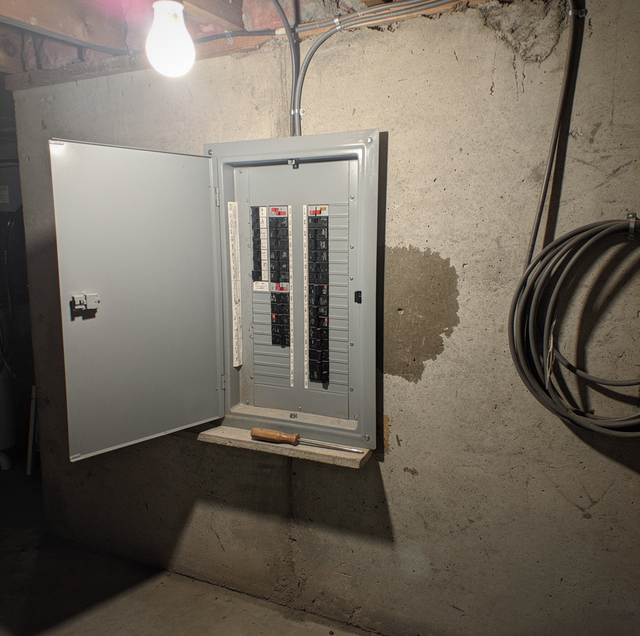
Somewhere behind a metal door in your basement, garage, or utility closet sits the single point that every circuit in your house runs through. Most homeowners never think about their electrical panel until something forces the issue: a renovation that adds new circuits, an electrician who flags it during another job, or breakers that trip more often than they used to. Once a panel upgrade comes up, the natural question is what that actually involves and whether the whole panel needs to be replaced or just added onto.
Why a Panel Runs Out of Room in the First Place
A panel isn't just a box of breakers. It's rated for the maximum current the main breaker and bus bar inside can safely handle, commonly 100, 150, or 200 amps in homes, with larger commercial and industrial services running higher. Every circuit added to the house, from a new kitchen appliance to a finished basement, draws from that same shared capacity.
Older homes were often built with panels sized for a much lighter electrical load than today's homes carry. A house wired decades ago for basic lighting, a refrigerator, and a few outlets per room now often runs central air, an electric range, multiple bathrooms with GFCI circuits, home office equipment, and increasingly an EV charger or two, all pulling from a panel that was never designed to carry that much at once.
The Difference Between Adding Capacity and Replacing the Panel
Not every panel problem needs a full replacement. There are a few different paths, and which one applies depends on what the existing panel can and can't do.
| Situation | What it usually needs | Why |
|---|---|---|
| Panel has open breaker slots and enough rated capacity | Add a new circuit only | The existing bus bar and main breaker can safely carry the added load |
| Panel is full but rated capacity has room | Tandem breakers or a small subpanel | Physical slots are the limit, not the amperage rating |
| Panel is at or near its amperage rating (commonly 100A) | Full panel upgrade to 150A or 200A | The bus bar and main breaker themselves can't carry more current safely |
| Home has a fuse box instead of breakers | Full panel replacement | Fuses can't be "added onto"; the entire panel and its wiring scheme are different |
| Adding major loads like an EV charger, hot tub, or workshop | Panel upgrade or subpanel, depending on remaining capacity | New continuous loads at that amperage often exceed what's left after existing circuits |
An electrician determines which row applies by running a load calculation on the existing panel, the same process used before adding any major new circuit. That calculation, not a guess based on the panel's age, determines whether a home needs a simple add-on circuit or a full service upgrade.
What Actually Happens During a Full Panel Upgrade
A full upgrade replaces the main panel, the main breaker, and often the meter base and service entrance wiring that feeds it from the utility connection. Every existing circuit gets transferred from the old panel to the new one, breaker by breaker, which is why this job typically takes the power out for most of a day rather than an hour or two.
The utility company is involved on the front end, since the service drop or lateral feeding the home has to be temporarily disconnected before work starts and reconnected once the new panel is in place and inspected. This isn't a step an electrician can skip or work around; it's coordinated ahead of the install date.
Once the new panel is set, every circuit is landed, labeled, and tested individually before power is restored to the house. This is also the point where a homeowner often adds circuits that weren't practical before: dedicated circuits for a workshop, an EV charger, or a generator transfer switch, since the new panel usually has more open slots and more available amperage than the one it replaced.
Why the Meter Base and Service Wire Matter Just as Much as the Panel
A brand-new 200-amp panel connected to a service wire and meter base that were only ever rated for 100 amps doesn't actually deliver 200 amps to the house. The wire coming in from the utility connection, the meter base, and the panel all have to be rated to match for the upgrade to have any effect. This is one of the more overlooked parts of a panel upgrade project: the visible panel swap is only half the job if the service-entrance wiring upstream of it isn't sized for the new rating.
Fuse Boxes Are a Special Case, Not a Bigger Version of the Same Job
A home still running a fuse box isn't a candidate for "adding a few breakers." Fuse boxes work on an entirely different physical and electrical arrangement than breaker panels, and there's no way to blend the two. Converting from fuses to breakers means a full panel replacement regardless of how much amperage the home actually uses day to day, because the fuse box itself, not just its capacity, is the thing being replaced.
How Long the Work Takes and What to Expect the Day Of
A basic panel upgrade in a home with accessible wiring typically takes one electrician crew a full working day, most of it spent transferring circuits and coordinating with the utility for the disconnect and reconnect. Power is out for part of that day, usually scheduled around when the utility can be present. Homes with more circuits, less accessible wiring runs, or a panel relocation (moving it to a different wall or a different level of the house) can take longer.
What This Means for Planning the Work
The panel itself is rarely the whole story. What decides the scope of the job is the load calculation, the condition of the service entrance wiring and meter base, and whether the existing setup is a breaker panel or a fuse box. An electrician who walks through all three of those before quoting the work is looking at the same things that determine whether your project is a simple add-on circuit or a full-day service upgrade.
Frequently Asked Questions
In practice, yes — a panel upgrade almost always goes through a permit and inspection, since it involves the utility service connection and the main disconnect for the entire home. An inspector typically checks the new panel's rating, grounding, and the labeling of every circuit before the utility reconnects the service for the long term.
Some utilities can coordinate a same-day disconnect and reconnect that keeps the outage to a few hours rather than a full day, but that depends on utility scheduling in your area, not just the electrician's timeline. It's worth asking about when the work is scheduled rather than assuming either outcome.
A panel upgrade is often when these get found and corrected, since every circuit gets identified and tested individually during the transfer. A double-tapped breaker or a circuit that was quietly overloaded in the old panel gets caught and fixed as part of the same job rather than staying hidden.
An updated panel, particularly one replacing an old fuse box or a brand of panel known for reliability issues, often affects both. Some insurers ask specifically about panel type and age when writing a policy, and an inspected, permitted panel upgrade is something a home inspector notes favorably during a sale.
A subpanel is a legitimate long-term solution when the main panel has enough remaining amperage capacity but has run out of physical breaker slots. It only becomes a workaround, rather than a real fix, when it's used to add load beyond what the main panel's total rated capacity can actually support. A subpanel also needs its own feeder wire sized for its full combined load, and if it's feeding a detached structure like a garage or workshop rather than another room in the same building, that typically means running a separate grounding electrode at that structure rather than relying on the ground path back to the main panel.
A standby generator needs a transfer switch tied into the panel, which is often planned into a panel upgrade at the same time rather than added afterward, since the transfer switch's location and wiring depend on how the new panel is laid out.
A panel that keeps pace with your home's actual electrical demand is the difference between breakers that hold steady and a system that's constantly working at its limit.
Schedule a panel evaluation — an electrician will run the load calculation and tell you exactly what your panel needs. Wired Up Electrical serves Lynchburg, Forest, and Bedford. Call (434) 254-1264.
